Planned and well-constructed defensive fortifications and lines can hold back an enemy for days, weeks, even months, or more, stalling their advance and forcing them to commit assets and men, with potential huge losses, into the fray. Breaching such defences is no easy task and tactics for doing so have evolved over a century of World Wars, and continue to evolve to this day.
This article looks back briefly to WWI and WWII to understand how tactics for breaching major defensive fortifications have evolved. It then examines lessons currently being learned in Ukraine, as that nation continues to defend itself against Russian forces. In doing so, it highlights how Ukrainian forces are adapting their approach and tactics to breaching defensive lines, largely taken from NATO’s playbook, in order to succeed in the face of new and latest battlefield threats.
Historical lessons
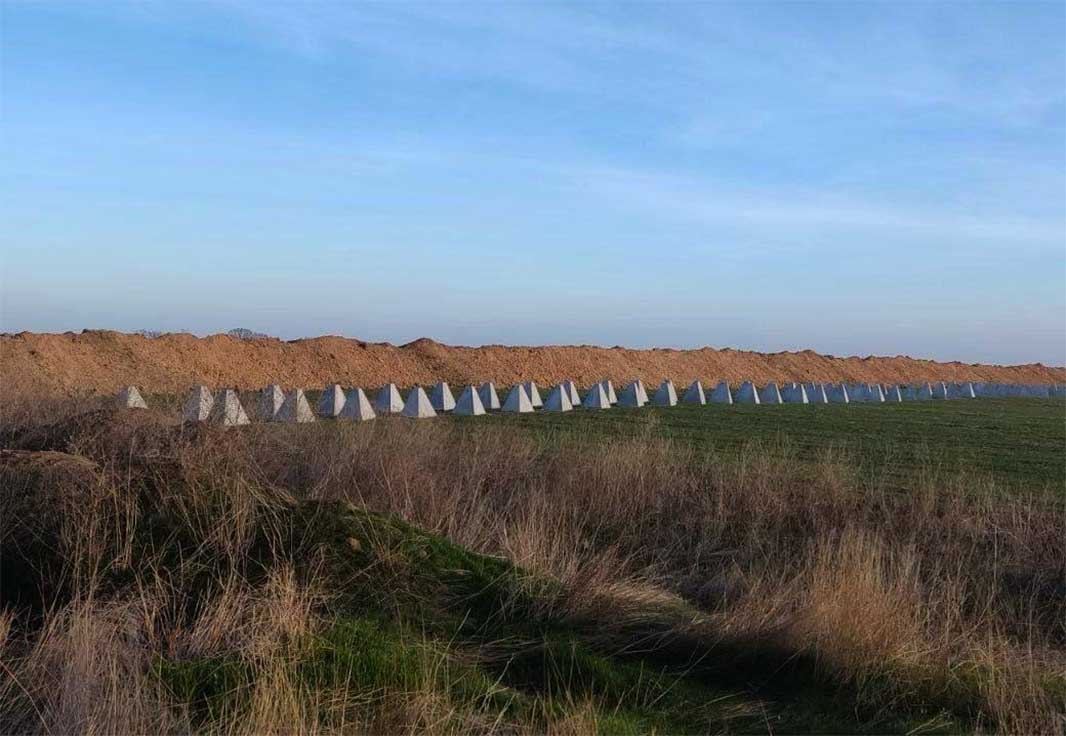
Two World Wars saw the trial-and-error emergence of new doctrine on defences and fortifications, which gave rise to some of the most elaborate defensive lines and fortifications ever constructed in wartime. In turn, defeating and overcoming them also drove new doctrine on the breaching of such defences. Built in depth, they often comprised layers of trench lines, dotted along their length with concrete pillboxes whose machine guns had interlocking arcs of fire covering every possible piece of open ground approaching such defences. Barbed wire in dense, overlapping belts, was designed to entangle, slow, and halt any attempt to penetrate the defensive line. Behind it, artillery was pre-registered on the foreground, middle ground, and rear approaches, with coordinates prepared for final protective fire (FPF) missions: a last-resort mission called only when an attacker was on the verge of breaching the final defences, and close-quarters combat loomed as the last remaining barrier to defeat. One example from history of such fortifications and scenarios was the infamous Hindenburg Line, (known as ‘Siegfriedstellung’ (ENG: Siegfried Position) to the Germans), in the face of which massive casualties mounted up among Allied Forces, through their repeated attempts to overwhelm the defences with massed infantry assaults, which failed at huge cost. Such futile attempts at breaching defences had repeatedly been the order of the day, in terms of doctrine, in the early stages of the war, when attempting to overcome trench fortifications and less fortified defensive lines than the Hindenburg using massed troop formations, regularly resulted in abject failure and huge losses.

It was the Hindenburg Line, however, which spurred the Allies on to develop new tactics, which they honed and employed against the defences from August to November 1918, in what became known as the Hundred Days Offensive. Rather than simply using massed infantry, Allied artillery was brought to bear along the whole line in massive bombardments. This destroyed fortifications, prevented the enemy from effective return fires, and also enabled their own infantry to advance under the protective umbrella of creeping barrages. Speed and surprise were also integrated into these new breaching tactics, as well as coordinating attacks at many different points along the defensive lines, so enemy reserves and reinforcements were spread too thinly to be able to effectively defend each locus of breaching attack. However, it was an overall emerging new approach of ‘combined arms operations’ together with these other changes, that enabled attacks to be driven forward, using artillery, engineers, infantry, the first tanks, as well as early aircraft and other units. These all worked in a coordinated fashion and in support of one another for the first time, helping to breach and overcome the Hindenburg Line during the war’s final months.
In WWII, the Siegfried Line, as the Allies then referred to it, again came into play as a major defensive fortification, though called the ‘Westwall’ by the Germans. Until late 1944, the line held, before the US XIX Corps broke through its defences north of Aachen in the Battle of Hürtgen Forest with superior and concentrated forces and manpower, though not without facing intense and bloody resistance from the Germans.
Another major WWII defensive fortification was the French Maginot Line, which the defenders believed would halt the German advance to invade France. However, German forces highlighted a major method of breaching, or overcoming, such a defensive obstacle when they chose to bypass and outflank the main Maginot Line defences altogether, something the French had considered impossible. Instead, the Germans pushed their way through the almost impenetrable forests of the Ardennes in Belgium and Luxembourg, which the French had assumed would stop heavy armour in its tracks.
Another WWII example of overcoming a major defensive fortification was played out through the famous Battle of Monte Cassino in central-southern Italy. In short, the hilltop monastery above the town of Monte Cassino, was the most formidable point on the German’s Gustav Line, and a crucial defensive part of their larger Winter Line, which ran from one coast of Italy to the other. Capture of the monastery was therefore deemed essential if the Allies were to advance on Rome successfully. However, some analysts look back and consider that the monastery was, perhaps, afforded more importance than Allied forces should have and, indeed, hindsight suggests the option of bypassing it altogether on the way to Rome, might well have turned out less costly. As it is, massive Allied artillery bombardments were brought to bear on the hilltop objective, along with intense tactical air support, in order suppress enemy positions before mounting infantry assaults. In the end, the monastery was totally destroyed and it took repeated efforts and four infantry assaults up the hillside before Allied success; the cost, however, was some 55,000 Allied troops either killed, wounded, or missing in comparison to 20,000 killed on the German side. As this highlights, breaching defensive fortifications and lines, unless absolutely necessary, with no alternatives, can be unacceptably costly.
Fast forward to today
Yet, despite such historical lessons, the formation of the UN and NATO soon after WWII, and a lengthy period of peace in Europe since, it seems we’re almost back to square one in a wartime European scenario. NATO Allies are gearing up for a wartime footing of sorts, some building defences and fortifications along their borders with Russia, though others waking up at a relative snail’s pace to what’s needed. Meanwhile, as an ally of NATO, Ukraine is fighting the bloodiest existential war seen in Europe since 1945. Its armed forces know defensive lines and fortifications like no other European nation, how to build and what’s required to breach them, including how breaching tactics have evolved.
While Russia has conducted its own breaching missions against Ukraine’s extensive defences, in some cases in repeated WWI-esque, meat-grinder operations, the Ukrainians themselves have learned that to breach Russia’s formidable defences, traditional combined arms operations are no longer sufficient and tactics have had to change.
The Ukrainians have understood the need for very precise reconnaissance of enemy lines and fortifications, including the use of drones and satellite imagery, to provide detailed views of Russia’s complex, integrated defences and such threats as dense and often multi-layered minefields. They have also modified a combined arms approach, integrating electronic warfare (EW), intel-gathering, and agility. Evolved tactics now place an emphasis on improved application of engineer assets and skills, alongside precise synchronisation of fires of all relevant calibres – including the exploitation of any discernible enemy weaknesses using deep strike weapons – to create a breach. This is followed up rapidly by boots on the ground to exploit a breach fully, though being cognisant of continual defensive adaptations and changes to fortifications likely being made by the enemy.

Many of the tactical changes Ukraine has made to its breaching approach/doctrine were learned the hard way during their September 2023 counteroffensive in the Donetsk and Zaporizhzhia Oblasts, when application of breaching fundamentals, known as SOSRA (suppress, obscure, secure, reduce, assault) failed to achieve the desired results. Russian fortifications were so dense and extensive, with layered and interlocking minefields, trenches and other fortifications, that it made conventional attack ineffective and costly, not to mention Russian use of huge numbers of reconnaissance and strike drones to detect and target formations of troops attempting to breach their lines. In addition, Ukrainian command and control was continually disrupted by Russia’s application of EW making communications with, and coordination of, its forces nigh on impossible.
Faced with a new battlefield of modern threats, Ukraine’s new breaching tactics now rely on real-time recon and targeting to provide as much information as possible and help in countering any enemy drone use. A new emphasis on precision, long-range strike using drones and missiles, targeting Russian logistics hubs, resupply, and command centres, are intended to degrade their ability to sustain the forward defences the Ukrainians are trying to breach. Systems such as Ukraine’s own Neptune or Flamingo FP-5 cruise missiles are key in this long-range-strike role; a new ‘Long-Neptune’ version of the cruise missile – introduced in August 2025 – is reported to be capable of hitting targets out to 1,000 km with a 150 kg warhead, improving on the 300 km range of its original version. Meanwhile, mass production has begun of the long-range Flamingo, which can reach targets out to 3,000 km with a 1,150 kg warhead; both are now formidable assets in Ukraine’s arsenal.
While traditional combined arms alone is no longer sufficient for such a task, the Ukrainians see an ‘improved’ version, synchronising combined arms assets more acutely with much improved artillery, engineer, and infantry integration, as being part of the answer. During the 2023 counteroffensive, coordination and momentum of these forces was degraded and their efforts became ineffectual. In addition, of paramount importance against extensive fortifications, the Ukrainians have worked develop and field new and more rapid ways to destroy and clear paths through minefields and obstacles, for instance, by making use of unmanned systems.

Having said that, Ukraine has learned that breaching well-prepared defensive lines is not a simple task, and massing troops for assaults carries risks of detection and being targeted with strike assets. As such, over most of 2025 the Ukrainians largely fought defensive battles, with the most notable counteroffensive efforts being near Pokrovsk and Kupiansk.
Closing thoughts
The experience of Ukrainian forces during their challenging and mostly ineffective counteroffensive of 2023, opened their eyes – and the watching world and Allied militaries, who must also learn from these events – that for a breach to be successful during large-scale combat operations, forces must have the capability to conduct extensive and detailed reconnaissance of the entire expanse of the area chosen for a breach. They must also employ sufficient assault forces backed up with support and logistics to prosecute the operation to fruition, and also apply fundamental SOSRA principles bolstered by today’s understanding of an evolved battlespace. Of crucial importance, engineering assets must be bolstered in number and employed in tandem, for any attempt to breach defensive lines to succeed. Attempting the breach of a major defensive line and fortifications will never be an easy task.
Tim Guest