An evolving demand for turreted, self-propelled (SP) mortar systems, has seen interest bolstered further in recent years by the geopolitics of the moment and changing battlefield threats experienced in Ukraine, with systems developed and emerging from European and allied defence manufacturers garnering interest, even from the US Army.
Raison d’être
The vulnerability of traditional infantry mortar crews, manually handling their weapons into and out of action under the constant threat of counter-battery detection and fire, as well as crews manning unprotected, vehicle-borne systems, is a problem nowhere more acutely and recently apparent, than on the battlefields of Ukraine. Weapon-locating and counter-battery radars of growing sophistication – alongside sound-ranging systems and reconnaissance drones – pose a constant threat. They can rapidly detect and geolocate the origin of mortar fire, feeding coordinates to fire-direction assets and often triggering swift counter-battery strikes. Transitioning in and out of action is a relatively slow process for a typical mortar section, and the fact that they operate much closer to the front than their artillery counterparts, also means the sensor-to-shooter response time, for any counter-battery fire heading their way will be shorter. Not to mention the threat from first-person view (FPV) drones.
As a result, mortar crews in Ukraine operating turreted SP mortar systems supplied by allied nations have expressed positive feedback about the performance and protection such systems provide. This, in turn, is driving continued growth in the market for turreted SP mortars. Mobile and responsive, these systems offer crew protection, with a sophisticated fire control system (FCS), networked into a wider tactical indirect fire support ecosystem. They combine high rates of fire, precision and new munitions with, in some cases, the ability to fire on the move. ‘Shoot-and-scoot’ tactics and armoured protection are no longer the preserve of just latest SP artillery; the mortars, too, can now evade those weapon-locating radars, be gone from their firing positions before the enemy has a chance to locate them, and be safe from small arms and shrapnel.
Scene set, this article takes two particular turreted mortar systems, which have emerged from European industry players in recent years, and which are playing a part in major vehicle programmes.
M120 Rak: Polish prowess, Ukrainian usage
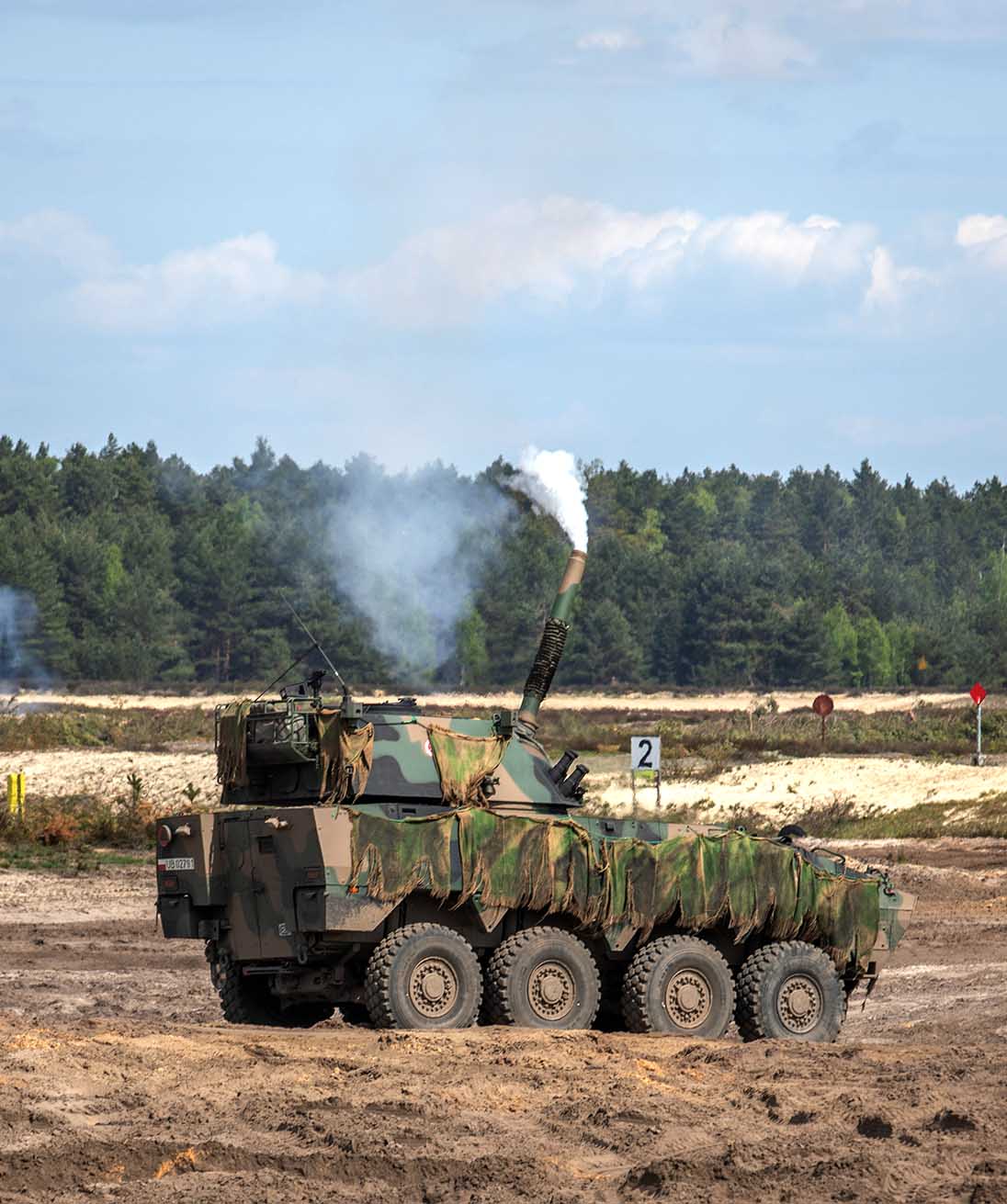
Produced by Huta Stalowa Wola (HSW), Poland’s 120 mm turreted SP mortar system, the M120 Rak, plays a key role in Poland’s artillery modernisation, having entered production soon after the country’s Ministry of Defence (MoD) placed a definitive order for 64 of the wheeled, M120K versions on 28 April 2016. The platform, mounted on the wheeled Rosomak 8×8 armoured personnel carrier (APC) version of the system, itself based on the Patria Armoured Modular Vehicle (AMV) 8×8 design built under licence, first entered service by the end of 2017, achieving the system’s initial operational capability; follow-on contracts in succeeding years have brought the total number of vehicles eventually to be procured to 122. By 2023, a 40 vehicle mix of Rak mortar carriers with a handful of command vehicles had entered service with Poland’s Armed Forces. In a follow-on timeframe, a tracked variant, the M120G, with an upgraded M120 Rak mortar turret mounted on HSW’s Borsuk platform, appeared as a technology demonstrator at the MSPO 2024 defence exhibition in Kielce, in September 2024, (a previous light tracked vehicle demonstrator appeared at an earlier incarnation of the same show in 2021, when the Rak turret was mounted on the HSW Opal light tracked platform). Nevertheless, wheeled or tracked, the standard breech-loading Rak mortar system is said to have a sustained rate of fire of 6-8 rds/min, largely enabled through the use of its automatic loader. From receipt of fire mission orders, the mortar can be ready to fire in 30 seconds, with the Rak turret having a full, 360° traverse capability, and -3° to +80° elevation capability. The mortar has a maximum range of some 10–12 km, using standard HE ammunition and the platform is able to accommodate 46 rounds (of which 20 are ready rounds), although storage capacity depends on ammunition type.
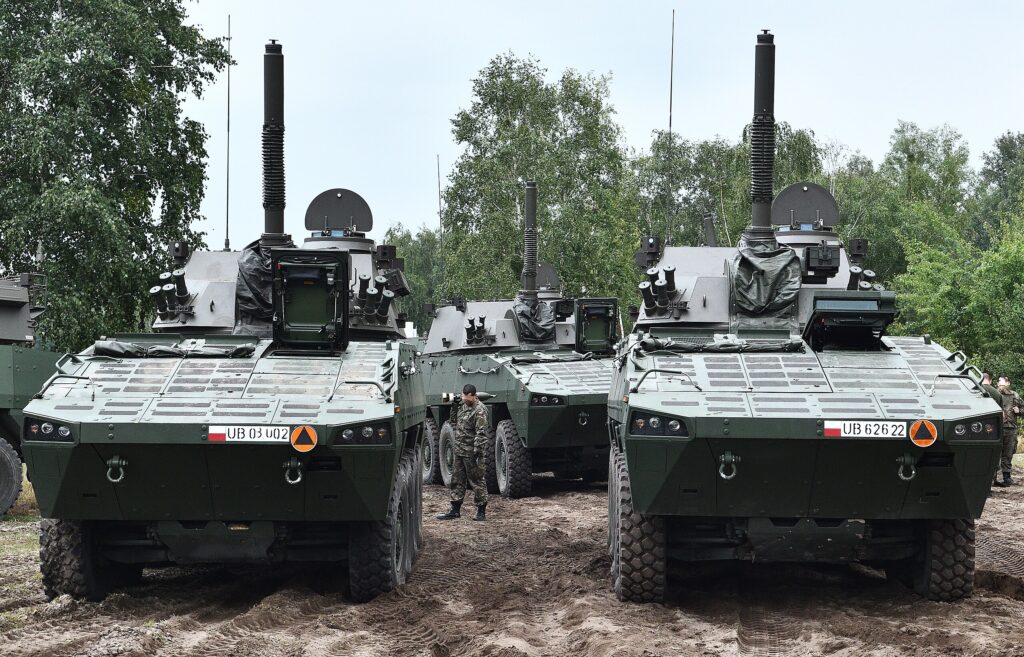
It is worth noting that upgrades on the M120G Borsuk tracked variant at MSPO 2024 included a new autoloader enabling an improved sustained rate of fire reported to be 10–12 rds/min, and a maximum rate of fire, reportedly, of 15 rds/min. In addition, the variant has a modified, lower-profile turret with a longer smoothbore barrel offering improved maximum range of some 13 km. The M120G also has improved armour with better ballistic protection, as well as an active protection system against larger-calibre rounds. The variant was also equipped with an integrated drone to provide recon, target detection/identification, and impact assessments following a fire mission.
An impending improvement to the platform’s mobility may result following the November 2025 announcement, that HSW signed an MoU with US military vehicle automatic transmission maker, Allison Transmission, for the design and production, under licence, of latest gearboxes. These will be incorporated into the powertrains of HSW’s combat vehicle range, with HSW’s management board president, Marek Karabuła, saying the agreement would give HSW access to latest technologies “that will be used in vehicles such as Borsuk, and in future projects based on tracked and wheeled platforms”.
Rak in Ukraine
Despite still building up its own numbers of the system, in April 2023, under a military aid package, Poland agreed to supply Ukraine with 24 of its relatively newly received, wheeled SP 120 mm M120 Rak systems, together with 12 fire control command post vehicles. Delivered by Q3 2023, the mortars entered service with the 44th Separate Mechanised Brigade and were deployed operationally almost immediately. Feedback by Ukrainian Forces in spring 2024, extolled the wheeled systems’ ability to ‘shoot and scoot’, confirmed its 30-second ‘TTBR’ (time to be ready), as well as the effectiveness of the autoloading system in helping crews achieve high sustained rates of fire using standard NATO 120 mm munitions against targets out to ranges between 10–12 km; ‘at least’ one wheeled Rak M120 had, however, been destroyed by that time.
Other than Poland and Ukraine, no other nations have yet become operators of the M120 Rak, despite its being actively marketed by HSW at overseas trade fairs, like the 2024 editions of the World Defense Show in Riyadh and Eurosatory in Paris. That said, overseas interest in the system is reported to have increased since the unveiling of various 2024 upgrades, including possible interest from the US Army in the Rak turret for its five-variant Armoured Multi-Purpose Vehicle (AMPV) programme, although a new mortar variant prototype for that programme is currently testing the Patria/Kongsberg NEMO 120 mm turreted mortar system.
NEMO: Finnish firepower, US interest
This brings us nicely to the US AMPV programme, well underway and set to replace the M113 family of vehicles within the US Army’s Armoured Brigade Combat Teams (ABCTs), over the next 20 years. Comprising five new variants, including an SP mortar carrier, more than 3,000 of the new vehicles are now on order following a recent additional 240 vehicle request. What proportion of the total fleet will eventually be mortar carriers is unknown at this time. What we do know is that AMPV fleet vehicle variants – general purpose, mortar carrier, mission command, medical treatment, and medical evacuation – will account for some 30% of the vehicles in each of the US Army’s 16 current ABCTs (which includes five National Guard combat teams). The intention is for all AMPVs, including the mortar carrier, to operate alongside other armoured fighting vehicles (AFVs) in the ABCTs, including M1 Abrams MBTs and M2 Bradley IFVs. Full-rate production of the AMPV fleet was awarded to BAE Systems by the US Army in August 2023.
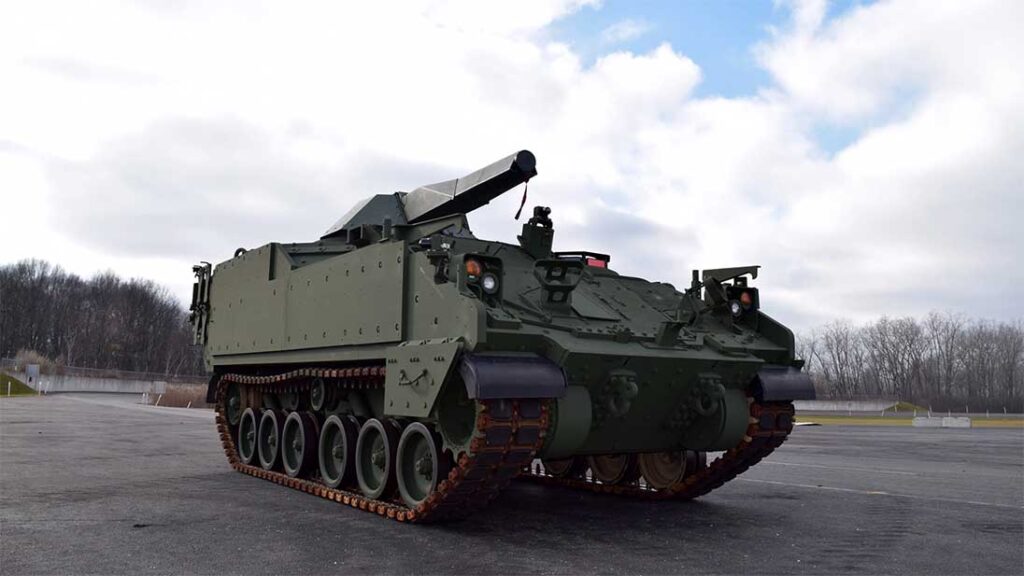
The AMPV mortar carrier variant, of which 386 are planned, is based on the US Army’s legacy 120 mm mortar system; the carrier, designated the M1287 Mortar Carrier, was expected to use the M121 mortar system with the M95 mortar FCS, with two vehicle crew and two mortar crew. However, in 2024, BAE Systems introduced a new top-plate system, the External Mission Equipment Package (ExMEP), which enabled a range of different turret types to be easily installed on the core platform. In the case of the MC, the company developed a prototype, unveiled in late 2024, with the ExMEP-equipped AMPV platform fitted with a Patria NEMO 120 mm remote turreted mortar system. The Pentagon and Patria had already been undertaking a Cooperative Research and Development Agreement since 2020 to explore how NEMO might be used with certain US Army vehicle platforms.
This development, according to BAE Systems, resulted from a rapid collaborative technology investment effort between itself, Kongsberg/Patria, and the US Army, to prove the versatility of the ExMEP-equipped AMPV platform in enabling incorporation of many different turret types, not just the NEMO mortar system.
At the time, AMPV programme director at BAE Systems, Bill Sheehy said, “The AMPV turreted mortar prototype was born from a capability discussion we had with the army in 2022, the same year ExMEP was conceptualised with industry partners, and we look forward to its evaluation.” The company said that using ExMEP enabled rapid integration of the NEMO 120 mm turreted mortar system, which offers both indirect, as well as direct-fire support across multi-mission scenarios.
Since its first appearance late 2024, the AMPV NEMO mortar carrier prototype has undergone several months of rigorous field trials and live firings during 2024/2025 to gauge user feedback, including at Fort Moore in Georgia. Next, let’s take a closer look at the NEMO in a European context.
NEMO
Patria’s NEMO 120 mm turreted mortar has already entered service with three countries (Saudi Arabia, Slovenia, and the UAE) and is on order with three others (Germany, Hungary, and Sweden) aboard a number of land and naval base platforms. However, a significant recent development is the NEMO’s inclusion for the mortar carrier variant of the Patria 6×6 – the platform being procured under the multinational Common Armoured Vehicle System (CAVS) programme, whose members include Denmark, Finland, Germany, Latvia, Norway, Sweden, and the UK. The primary variants offered under CAVS include: armoured personnel carrier (APC), command and control (C2) command post vehicle, logistics/support vehicle, engineer vehicle, MEDEVAC vehicle, and the NEMO-turret-equipped self-propelled mortar. Thus far, Germany is the sole CAVS member confirmed to have purchased the NEMO mortar carrier variant of the Patria 6×6, with 69 units on order. However, combined member orders for all CAVS variants now total over 2,000 units, with 250 already delivered and quantities increasing regularly, and with such a large user base, further procurement of the mortar variant appears likely.
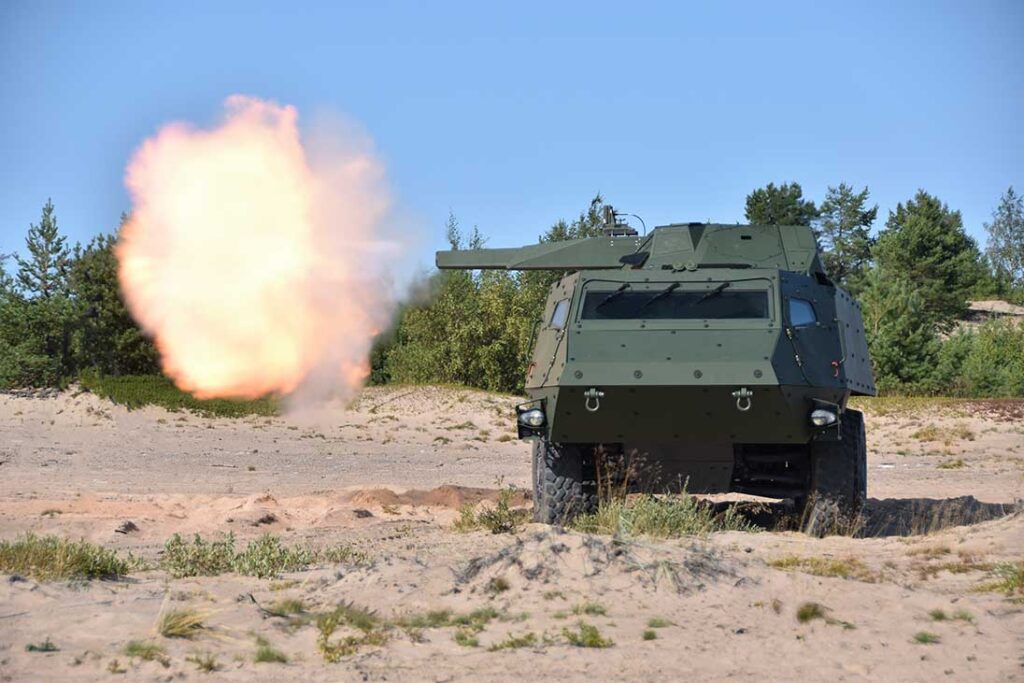
The NEMO turret itself is a 120 mm mortar system designed for indirect fire support, but with a direct-fire capability; its breech-loading mechanism and stabilised turret enable it to fire at the low-elevation angles required for direct-fire engagements, for which it also has a laser rangefinder and day/thermal imaging cameras.
NEMO is also capable of multiple rounds simultaneous impact (MRSI) fire missions, during which up to five mortar rounds can be fired, so that the rounds land on an area target almost simultaneously, and with under four seconds between each impact. It can also conduct multiple targets simultaneous impact (MTSI) fire missions, in which up to five bombs are fired at nearby individual target coordinates, so that the rounds land on their targets almost simultaneously. MRSI/MTSI fire missions are possible at ranges between 1 km to 6.5 km. Both direct and indirect fire missions can be conducted either while the vehicle is stationary or on the move.
With a crew of two or three, the NEMO RC turret weighs 1,900 kg and has a full 360° traverse, with an elevation range from -3° of depression, to +85° elevation. The turret has an electrical laying system, but with manual back-up, if necessary. It has a 3 m, 120 mm smoothbore barrel, notionally a semi-automatic loading system (albeit a 2025 Patria NEMO brochure made reference to an automatic loading system, suggesting this is now also offered), again with manual back-up, and a soft, hydro-pneumatic recoil system. The platform can carry 50–60 rounds of ammunition, while the mortar itself can fire all NATO standard, smoothbore, 120 mm rounds, as well as certain precision-guided munitions. The turret is also offered with smoke grenade launchers for protection and an integrated remote weapon station as a secondary armament.
According to the manufacturer, based on user feedback and trials, NEMO can be ready to conduct a fire mission within 25 seconds of receiving orders; its FCS enables sensor-to-shooter operations, receiving fire support plans and fire missions from the fire direction centre via the wider tactical data network into the onboard C2 systems. Its ‘shoot-and-scoot’ capabilities include being able to fire on the move; it can fire the first three rounds of a fire mission in 15 seconds, but has a sustained rate of fire of 6 rds/min, thereafter, and a maximum rate of fire of 10 rds/min. Depending on ammunition type, NEMO can hit targets over 10 km away.
Tim Guest
Author: Tim Guest is a long-time freelance defence journalist, UK Correspondent for ESD, a former communications specialist in the defence industry, and, previously, an officer in the British Army.