Driven by the realities of modern warfare, unmanned ground vehicles (UGVs) are evolving rapidly, reflecting their increasing operational importance on the battlefield. More importantly, combat employment prompts innovations in both tactics and technology, which in turn expands the range of combat and support roles for UGVs, with many new roles having emerged in recent years.
The Russo-Ukrainian conflict serves as a catalyst for innovation not only among the belligerents but also among numerous third-party states observing and analysing the conflict. Consequently, the experience of ground warfare in Ukraine often translates into transformative changes in tactics, technology, and doctrine worldwide.
One area that has seen the most extensive development is unmanned ground systems. Over recent years, both Russia and Ukraine have invested heavily in UGV technology, resulting – by early 2026 – in a surge in deployed systems and an expansion of their combat and support roles. In March 2025, Ukrainian news outlets, citing a Ministry of Defence official, reported that the Ukrainian military planned to deliver over 15,000 UGVs by the end of 2025. This represents 7.5 times the estimated 2,000 UGVs produced in 2024 (a 650% increase). While the Russian Ministry of Defence and military industry officials do not disclose precise figures, Russia appears to be following a similar trajectory, with more systems entering low-rate serial production, experimental combat employment, and field-testing.
Ukraine and Russia exemplify a broader global trend toward autonomous ground systems. The military UGV market is expected to grow from USD 3.07 billion in 2024 to USD 6.35 billion by 2032, at a Compound Annual Growth Rate (CAGR) of 8.6%. Arguably, the most significant consequence of this wider adoption and combat use is the emergence of new applications for autonomous systems, alongside the validation of older concepts.
Existing and emerging
Before examining specific cases in detail, it is necessary to note that changes in contemporary warfare have brought to the fore several key challenges and debates surrounding the development and employment of unmanned ground systems. Unlike the air and maritime domains, the land domain has proven to be, and remains, the most challenging environment for robotic systems, with ground combat representing the most complex operating conditions. Despite recent advancements, many of these difficulties remain unresolved and have been further intensified by evolving battlefield dynamics.
At the same time, the emerging threat environment and operational realities on the ground have reshaped the understanding of which platforms are in demand, altered key technical and performance requirements, and redefined the roles assigned to UGVs. Consequently, several pre-2022 concepts have been deprioritised, while others have emerged or expanded in direct response to battlefield necessity. Both the pre-2022 applications and newly emerging roles of UGVs are discussed below.

Armed platforms
Prior to 2022, armed UGVs were envisioned as one of the core components of future warfare, with a strong emphasis placed on large and medium-sized platforms. Today, although these platforms remain under development and continue to undergo trials in many countries, there is no evidence of their deployment – let alone large-scale employment – in contemporary conflicts, whether in Gaza, the Thai–Cambodian border clashes, Ukraine, or other small- or large-scale wars. Instead, as indicated by the experience of the Russo-Ukrainian conflict, interest in smaller and cheaper multipurpose UGVs has grown over the past two years.
The armed variants typically consist of wheeled or tracked platforms with a combat weight below 1 tonne, armed with a 7.62 mm (and more rarely 12.7 mm) machine gun or grenade launcher, and equipped with onboard electronic warfare (EW) systems. These systems can be employed in an overwatch role, for perimeter defence, ambush operations, or as stationary fire points. A critical and as yet unresolved limitation remains their dependence on human oversight for operation, as well as direct human involvement in maintenance and ammunition resupply. At present, the use of UGVs for direct fire support or indirect fire missions remains limited and largely experimental.
Logistic support
In contrast to armed UGVs, demand for autonomous logistics platforms has expanded significantly in response to the challenges of sustainment and resupply in the contemporary battlespace. Based on publicly available data, light unmanned logistics vehicles – weighing below 1 tonne – now constitute the majority of UGV fleets fielded by the Russian and Ukrainian armed forces, which currently represent the largest operators of unmanned ground systems worldwide.
Despite the apparent increase in the number of deployed logistic UGVs, their contribution to the entirety of logistic operations remains marginal. For example, according to statements by Russian Minister of Defence Andrey Belousov: “In 2025, all-terrain vehicles, as well as aerial and ground robotic systems, began to be used extensively and delivered over 12,000 tonnes of various cargo, whereas in the previous year their employment had been sporadic.” In 2026, this figure is expected to increase by at least twofold. This number can be compared to the general volume of cargo transported by the Russian logistic system for the groupings engaged in the zone of the Russo- Ukrainian conflict, which amounted to 8 million tonnes in 2024. This gives UGVs an input of approximately 0.2% of the overall volume.
Limitations in mobility, platform size, and payload capacity of light platforms, however, remain the primary constraints on the use of unmanned logistics systems in high-intensity conflict, particularly for supporting large-scale operations or the sustainment of heavy equipment.
CASEVAC
The growing demand for CASEVAC unmanned ground vehicles is driven by several factors, including the proliferation of reconnaissance and strike assets at the tactical level. Indeed, the “transparency” of the modern battlespace – combined with the dispersion of troops – has made the CASEVAC mission increasingly difficult for traditional means, such as motor transport or armoured vehicles.
Typically, CASEVAC capability is integrated into logistics platforms, which are frequently employed in a dual role. As the experience of the Russo-Ukrainian conflict shows, light unmanned platforms that deliver supplies to forward positions and return with casualties (typically on stretchers, open beds, or sledges) represent an extremely common – and often predominant – use case.
The modern threat environment, however, is prompting the development of medium-sized dual-role or even standalone CASEVAC platforms, such as the Russian Nerekhta or Marker UGVs. The reasons for experimentation in this direction include the extreme vulnerability of light UGVs to enemy fire, their inability to accommodate a medic or stabilisation equipment due to limited size, and their susceptibility to enemy interference or jamming. It is therefore possible that, in the near future, priority will be given to larger, better-protected, and optionally manned platforms, in which a medic could assume manual control in the event that the platform loses connectivity or autonomous functionality.

One-way explosive UGVs
The origins of one-way explosive UGVs, also known as ‘kamikaze drones’, can be traced back to both the First and Second World Wars. While technological developments have enabled the revisiting of this concept in the 21st century, the widespread employment of such vehicles remains limited by two main factors. First, as described above, the modern ground battlespace remains increasingly challenging for the deployment of autonomous systems. Second, from a tactical perspective, the mission of a one-way explosive UGV can often be accomplished by alternative means, including high-precision munitions and aerial drones. There are documented instances in which kamikaze drones in various forms – ranging from small UGVs to robotised armoured fighting vehicles (AFVs) – have been deployed both in Ukraine and Gaza. However, their employment remains sporadic and is often dependent on a combination of operational factors and favourable conditions. In most documented cases, one-way explosive UGVs have been employed for the demolition of obstacles, field fortifications, or minefields.
Reconnaissance and ISR
In doctrinal terms, most UGVs possess an inherent reconnaissance function, as they are equipped with sensors and secure data links capable of supporting command-and-control (C2) processes. However, recent operational experience has driven the emergence of purpose-built reconnaissance UGVs and modular intelligence, surveillance, and reconnaissance (ISR) payloads, constituting a distinct and rapidly expanding subclass of unmanned ground systems optimised for ISR tasks. The models that have emerged since 2020–2022 include, for example, THeMIS OBSERVE, Rheinmetall’s Mission Master UGVs equipped with modular ISR payloads, Kalashnikov’s Marker, and Guardium/Guardium-LS by G-NIUS, among others.
These light platforms offer superior concealment due to their small size, electric propulsion, and reduced acoustic and thermal signatures, and are therefore well suited for roles such as forward observation, acoustic detection and localisation, and target designation. Typical payloads include day- and night-capable electro-optical/infrared (EO/IR) sensors, acoustic sensors, radars, and laser rangefinders. Combined with a modular architecture, this allows payload configurations to be tailored to specific missions, terrain, or operational theatres. Recent developments also indicate an increasing emphasis on AI/ML-enabled data processing and autonomy.
Notably, despite the growing reliance on aerial ISTAR assets, unmanned ground systems offer several unique advantages, including the ability to conduct reconnaissance and observation with a lower probability of detection, to maintain persistent observation over extended periods (including in low-power modes), and to access areas or terrain inaccessible to aerial reconnaissance assets. There are, however, limiting factors, with the cost of the sensor suite being among the most significant. In some cases, the cost of the ISR payload may exceed that of the platform itself, which constrains wider adoption.

Sapper and engineering support
Over the past decade, engineering UGVs have been regarded as an essential capability by most advanced militaries. In recent years, however, engineering UGVs have undergone particularly extensive development, and by 2026 an entire and rapidly expanding UGV sub-class has emerged.
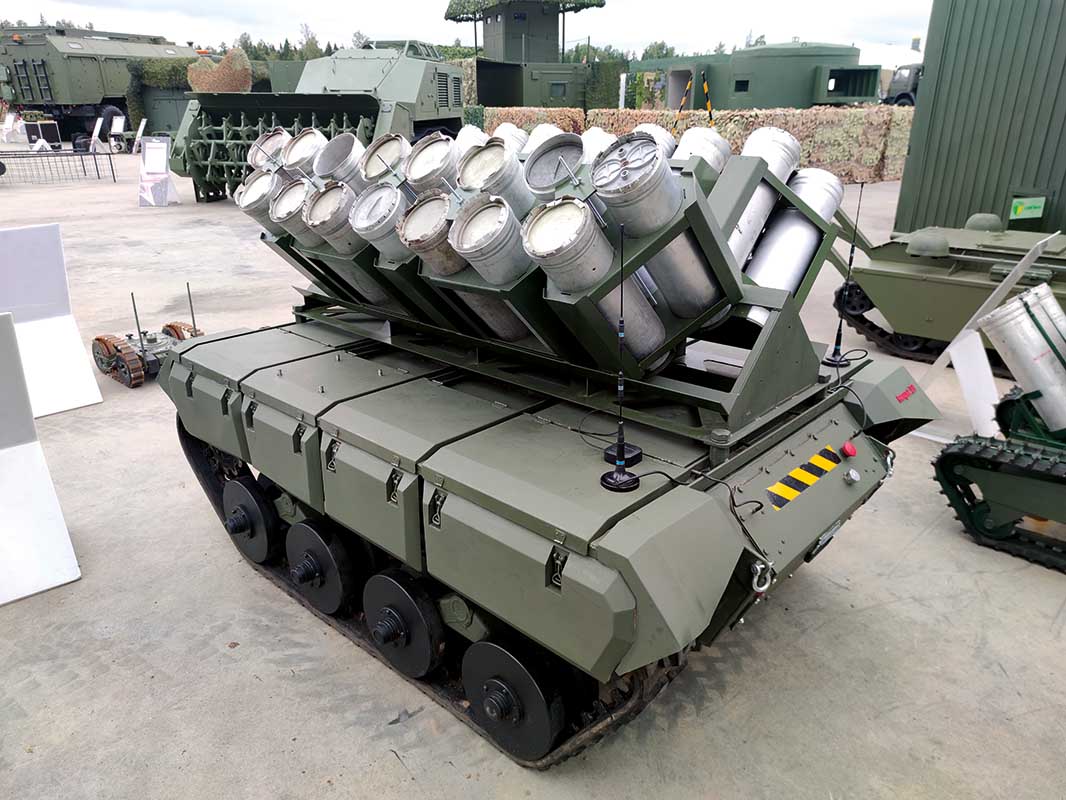
Beyond established functions such as Explosive Ordnance Disposal (EOD) and mine clearance in rear areas, a growing number of engineering UGVs have been developed for direct combat engineering support. These systems, which largely fall within the light UGV category, provide capabilities including mine laying, obstacle breaching (including the placement of explosive charges), bridge and gap-crossing support, barrier emplacement (such as barbed wire), smoke deployment, and related tasks. In addition, some variants are specifically configured for engineering and route reconnaissance.
Electronic warfare (EW) system carrier
Electronic warfare (EW) suite-carrying UGVs represent a relatively new capability that has emerged in response to the growing threat posed by aerial reconnaissance and strike UAVs. In principle, ground-based unmanned EW carriers offer a broad range of potential applications, from accompanying infantry under an EW “umbrella” to securing perimeters, patrolling logistics routes, and protecting high-value assets such as air-defence systems, tube and rocket artillery, radars, and command posts.
In footage released by the Russian Ministry of Defence in August 2025, one such employment concept was demonstrated light unmanned platform equipped with onboard EW systems was shown accompanying a 2S19 Msta-S self-propelled howitzer. According to the footage, the UGV is capable of speeds of up to 15 km/h across rough terrain and requires an operator for remote control. Employment of this system enables a reduction in the thermal and acoustic signatures of the SPH while its engine is shut down. At the same time, the UGV’s EW suite provides protection for both the howitzer and the accompanying anti-drone infantry detachment.
This, however, appears to represent an isolated and likely experimental case. Nevertheless, wider future use of unmanned EW system carriers is probable. During 2024–2025, multiple instances of UGVs equipped with onboard EW systems for self-defence were documented.
Air Defence System Carrier
The demand for short-range and ultra-short-range air defence (SHORAD/U-SHORAD) solutions has steadily increased over the past five years, driven largely by operational lessons from conflicts such as Nagorno-Karabakh, the Russo-Ukrainian War, and various low-intensity engagements in the Middle East. The primary driver has been the need to counter reconnaissance and strike UAVs, both on the battlefield and in rear areas. This has spurred the emergence of new systems, as well as upgrades across the spectrum of existing capabilities.
A number of UGV-mounted SHORAD/U-SHORAD systems, specifically tailored to counter emerging aerial threats such as drones and loitering munitions, have been introduced. These include for example Milrem’s THeMIS with Stinger Vehicle Universal Launcher (SVULL), Rheinmetall’s Mission Master CXT fitted with the Oerlikon Skyranger, or a Mission Master CXT equipped with twin Dillon Aero M134D miniguns, a radar, an electro-optical sensor suite, and an AI-based target detection and tracking system, according to the manufacturer. Meanwhile, Ukraine’s 28th Mechanized Brigade has tested (and demonstrated) an unmanned ground system armed with a 9K38 Igla MANPADS.
While developments in this area are ongoing, demand for U-SHORAD solutions is expected to continue growing in the near term, with more unmanned platforms entering field tests and operational deployment. Potentially, two operational subclasses may emerge: one designed for frontline deployment— including U-SHORAD for small infantry units—and another comprising larger platforms intended to secure rear areas, infrastructure, and static assets.

In conclusion
The recent evolution of ground warfare has reshaped the roles previously envisioned for UGVs, emphasising capabilities that address immediate battlefield needs while deprioritising others. The most dynamically developing roles are:
- Logistics and resupply (high-volume, routine delivery under threat);
- Engineering and obstacle/breach support (route clearance, mine neutralization, fortification);
- Systems carriers for EW and ISR (forward observation, jamming, counter-UAS protection).
SHORAD/U-SHORAD applications on UGVs remain largely experimental or in early testing, with limited operational scale to date. Current development focuses on small platforms (typically under 1 tonne), which are mostly remotely controlled, require human oversight, and offer better concealment and deployability. #
While numerically more UGVs are entering service and the spectrum of their roles has expanded, wider adoption remains constrained by tactical and technical factors, including protection, payload capacity, endurance, the need for human oversight, and mobility on severely degraded terrain. These limitations are expected to be addressed by larger unmanned platforms (up to 10 tonnes) currently in advanced development or limited testing.
In doctrinal terms, the path forward is a tiered UGV ecosystem: small, attritable, human-supervised systems for lower tactical levels, progressively complemented by larger, more capable and protected platforms to support higher-end roles in high-threat environments as maturity increases. This lessons-driven progression – rooted in ongoing high-intensity conflict – will shape the next phase of unmanned ground operations.
Alexey Tarasov
Author: Alexey Tarasov is a land warfare expert specialising in Europe, Russia, and armoured vehicles. He has contributed to ESD, Shephard News, along with other publications, and has authored several books.
Click here to read the latest issue of ESD.