In his second term in office, Donald J. Trump has presented himself as a global peacemaker: A slogan “Stop the wars” has become a new mantra since his inauguration in January 2025. In October 2025, President Trump claimed that he had “ended eight wars.” This article analyses the Trump administration’s approach in attempting to resolve three conflicts, each of which has significant and wide-ranging inter-regional implications: Armenia-Azerbaijan, Russia-Ukraine, and Israel-Palestine. In the process, it highlights some trends in current US foreign policy.
The Armenia-Azerbaijan road to peace. Deal!
As a consequence of the 2020 Nagorno-Karabakh war, followed in September 2023 by the forced exodus of the entire ethnic Armenian population from Nagorno-Karabakh, Azerbaijan not only reestablished full control over its internationally recognised territory but also took over some parts of Armenian territory. Armenia’s significantly weakened position in the region has allowed Azerbaijan to repeatedly demand concessions in the ongoing negotiations around a peace treaty.
Against this background, President Trump initiated a high-level summit with the leaders of Armenia and Azerbaijan in Washington DC, where on 8 August 2025 all three signed a joint Declaration. The first paragraph of the Washington Declaration confirmed that Armenia and Azerbaijan agreed upon a text of The Agreement on Establishment of Peace and Inter-State Relations. The signatories reaffirmed the importance of the opening of communications between Armenia and Azerbaijan with reciprocal benefits “on the basis of respect for the sovereignty, territorial integrity, and jurisdiction of the States.”
As for now, the implementation of the bilateral Armenian-Azerbaijani Agreement formally depends upon the willingness of the Armenian side to remove from the Constitution a referral to the Declaration of Independence which includes a statement on “Reunification of the Armenian SSR and the Mountainous Region of Karabakh (December 1, 1989).” Azerbaijan views it as Armenia’s territorial claims and the main remaining obstacle to a lasting peace with Armenia.
The most intriguing part of the Washington Declaration is a proposed “Trump Route for International Peace and Prosperity” (TRIPP) as a segment of the so-called ‘Middle Corridor’ connecting Europe to Central Asia. Concisely, implications of TRIPP for the interested parties are the following:
- For Azerbaijan, the establishment of a direct connection with its Nakhichevan Autonomous Republic and Türkiye through Armenia’s sovereign territory, the Syunik region, which has strategic importance for Armenia;
- For Türkiye, a cementing of its presence in the South Caucasus and a direct connection with Azerbaijan and Central Asia;
- For Armenia, open borders with Türkiye and Azerbaijan, and a connection through the Azerbaijani territory to the ‘Middle Corridor’.
For the US, TRIPP creates an opportunity for a broader involvement in the South Caucasus and correspondingly in the Greater Central Asia. It is notably viewed as leverage to reduce Russia’s space for manoeuvring, to isolate Iran, and – to some degree – to constrain China.
According to available information, Armenia will lease a 43 km-long piece of its land for 99 or 49 years to the US; the American private companies as subcontractors, presumably with their security personnel, will receive exclusive development rights along this route, including a construction of a railway and a highway and necessary infrastructure. No third country can deploy its military force along this route.
In addition to the Declaration, Armenia and Azerbaijan signed bilateral Memoranda of Understanding (MoU) with the US. Armenia’s three MoUs cover the capacity-building of Pashinyan’s ‘Crossroads of Peace’ project, a partnership in energy security sector, including civil nuclear energy, and in AI and semiconductor innovation sectors. These MoUs complement the Armenia–United States Strategic Partnership Charter signed on 14 January 2025.

The US-Azerbaijan MoU is a first step toward an Azerbaijan–United States Strategic Partnership Charter. Its three areas include in particular regional connectivity in energy, transit, and trade, investments in AI and digital infrastructure, security cooperation in defence sales and counterterrorism cooperation with strong mutual commitments. In addition, the Azerbaijani state oil company SOCAR signed a second MoU with American ExxonMobil which holds a 2.5% stake in the Baku-Tbilisi-Ceyhan (BTC) and 6.79% in the Azeri–Chirag–Gunashli (ACG) pipelines.
Challenges:
- The Washington Declaration does not contain any legal obligations;
- Russia and Iran can take steps to protect their strategic interests, in particular in the North-South Corridor;
- It is not clear whether the Armenian-Iranian border will remain under joint Armenian-Russian border guard protection;
- The financial aspect of the deal is not announced. The real estimate of the TRIPP-related expenses and its profitability are lacking;
- Internal political turbulence in Armenia before and after the 2026 parliamentary elections can postpone the implementation of TRIPP for an indefinite period.
According to Armenian sources, President Trump intended to ask his Azerbaijani counterpart to release “23 Christian prisoners” who were captured after the Armenians exodus from Nagorno-Karabakh, and who are on trial in Baku.
The Israel-Palestine enigma: A new deal?
President Trump’s first term in office was marked in the Middle East by a recognition of the Israeli occupation of the Syrian Golan Heights, the signing of the Abraham Accords, and a relocation of the US Embassy from Tel Aviv to Jerusalem. The main goals were to bring some Arab states (Bahrain, UAE, Morocco, Sudan) and Israel closer to each other, to please the president’s pro-Israeli donors, and to eliminate any chances to call East Jerusalem a capital of the future Palestinian state.
The two-year Israeli-Hamas conflict has seriously influenced US domestic policy, becoming one of the dividing lines between the US and its allies. It has divided Israeli society, had catastrophic consequences for the Palestinians, and has also shaped the entire Middle East. Therefore, a cessation of hostilities, which would be followed by a ceasefire agreement, became a priority for President Trump. His vision and statements regarding the future of Gaza has varied from the Gaza Strip as the “Riviera in the Middle East” (February 2025) to a vague promise of a “Palestinian self-determination and statehood as the aspiration of the Palestinian people,” in a 20-point Comprehensive Plan to End the Gaza Conflict (29 September 2025).

Phase One of the Plan, which went into effect on 10 October 2025, includes a return of all Israeli hostages and the bodies of the deceased in exchange for a release of Palestinian prisoners and remains of Gazans, an opening of passage for humanitarian aid, and a withdrawal of Israeli troops to a ‘yellow line’ inside the Gaza Strip. However, implementation of even this phase faces real obstacles on the ground.
The crucial part of the Plan combines a withdrawal of the Israeli Defense Forces (IDF) from Gaza with the disarmament of Hamas and the establishment of a “transitional governance of a technocratic, apolitical Palestinian committee.” This committee would act under the supervision of a “new international transitional body, the “Board of Peace”, which will be headed and chaired by President Donald J. Trump”. A temporary International Stabilization Force (ISF) should be immediately deployed to Gaza and remain there until their replacement by vetted Palestinian police forces. US troops will not be deployed in the area of the conflict. Interestingly, the US Administration did not insist on an immediate disarmament of Hamas: on 14 October, President Trump acknowledged that Hamas needs “to take out a couple of gangs”.
To receive international support, the US Administration needed to first bring on board Arab and Muslim-majority states and to reduce criticism from European states, Russia, and all others who recognised the Palestinian statehood and condemned the Israeli actions in Gaza. Therefore, and despite the fierce pressure from the Israeli government, the Plan could not avoid mentioning Palestinian statehood. Second, the American side needed to assure the potential participants, especially those who could secure a military presence in Gaza, that their presence and actions are legitimate. The US team of negotiators (Steve Witkoff, Jared Kushner, JD Vance) warned both sides that if its efforts failed, the fragile ceasefire in Gaza would collapse immediately. These efforts resulted in the adoption of UNSC Resolution 2803 (2025) on 17 November 2025.
The key elements of the Resolution include brief mention of a possible “Palestinian self-determination and statehood” after the implementation of several preconditions, such as a demilitarisation of Gaza, the fulfilment of the Palestinian Authority’s reform programme, a redevelopment of Gaza, the establishment of a transitional governance administration of a “technocratic, apolitical committee of competent Palestinians from the Strip”, and the establishment of a “temporary International Stabilization Force (ISF) in Gaza under unified command acceptable to the BoP (Board of Peace; whose mandate extends to 31 December 2027)”. The main tasks of the ISF are the demilitarisation of Gaza, “including the destruction and prevention of rebuilding of the military, terror, and offensive infrastructure, as well as the permanent decommissioning of weapons from non-state armed groups.” The West Bank was not mentioned in the Resolution.
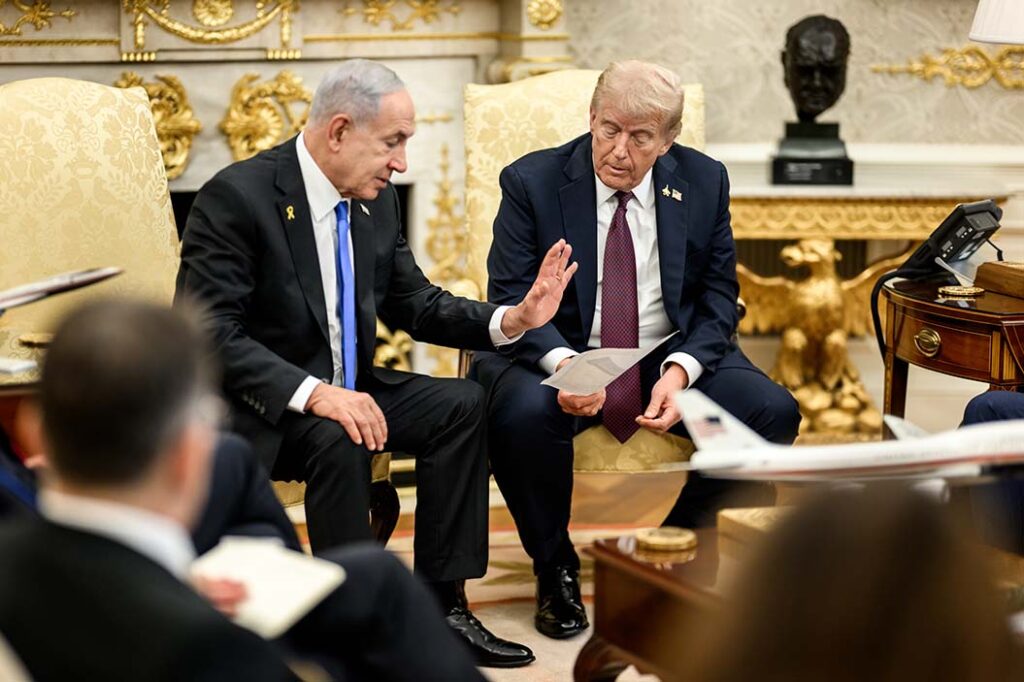
Prior to the UNSC vote, the US took an important step to ensure some success of its stabilisation efforts. On 17 October 2025, US CENTCOM opened a Civil-Military Coordination Center in southern Israel, near the Gaza border. It will serve as a “main coordination hub for Gaza assistance,” which is crucial for reducing an Israeli control over the humanitarian aid entering the Palestinian territory.
However, on 14 November, the US and Israel announced a decision to divide the Gaza Strip into ‘red’ and ‘green’ zones. The former, where the overwhelming majority of Gazans is currently concentrated, will be left in ruins; the latter will be established to the east of the ‘yellow line’ and will be reconstructed under Israeli and international military control. An established trust fund will supervise the reconstruction, and the necessary financing will be provided by the World Bank and – presumably – by the Gulf Arab States.
Challenges:
- A permanent strong opposition of the Israeli government to the establishment of Palestinian statehood;
- Hamas’ rejection to disarm voluntarily;
- Continuous attacks of the Israeli military in Gaza despite a ceasefire, and attacks by Israeli settlers on Palestinians in the West Bank;
- A lack of enthusiasm from possible contributors to the ISF: Egypt, Indonesia, the UAE, Türkiye, and Azerbaijan refer to security threats prior to a complete demilitarisation of Hamas; Israel rejected the participation of Turkish military forces; Jordan, as a home for approximately three million Palestinians, was apprehensive to participate due to moral concerns around their troops potentially being required to use force on Gazans to enforce peace. Italy is the only European state considering its participation in ISF.
Russia – Ukraine stalemate. No deal (so far).
President Trump’s approach to the Russia-Ukraine War was marked by a swift U-turn from Biden’s “nothing about Ukraine without Ukraine” to ‘almost everything about Ukraine without Ukraine’. In Trump’s view, Ukraine and its defence is primarily a problem for European states. He is also against direct US military supplies to Ukraine unless NATO allies want to buy the weapons from the US and transfer them to Ukraine. Trump also rejects direct participation of US military either in Ukraine’s defence or in peacekeeping operations there, and – last but not least – President Trump himself has shown a willingness to negotiate the conditions of peace directly with President Putin, to the exclusion of President Zelenskyy and European allies.
Several important nuances should be considered:
- The erratic policy of President Trump is in contrast to President Putin’s strong vision of post-war Ukraine and Europe, in general;
- Ukraine appeals to international law while Russia refers to a resolution of the “root causes”;
- The US mediators’ team has been divided into two groups to hold separate discussions with Russian and Ukrainian counterparts; however, members of both groups, with little or no diplomatic experience, have conflicting views on the resolution of the war. Hence, something can be ‘lost in translation.’

For Kyiv, the most significant and painful consequences of Washington’s changed approach are related to US military supplies and President Trump’s view of Ukrainian territorial integrity. The potential loss of access to US intelligence became a permanent threat to Ukraine after the US suspended intelligence sharing for two weeks in March 2025. Military aid was completely frozen between March and July 2025, followed by limited supplies of some types of weapons. On 14 July, the US Administration introduced the Prioritised Ukraine Requirements List (PURL), a new package of military assistance to Ukraine making clear that there will be no direct and, especially, unconditional US military supplies to it; NATO member states should buy modern American weapons and deliver them to Ukraine. In parallel, President Trump has threatened Russia with sanctions and once – after he was “disappointed” by President Putin after a round of negotiations in October 2025 – imposed them.
President Trump’s approach to the issue of Ukraine’s territorial integrity contradicts the Crimea Declaration which he signed in July 2018, and which rejected “Russia’s attempted annexation of Crimea”. At that time, the US pledged to maintain this policy until a restoration of Ukraine’s territorial integrity. Currently Washington is attempting to convince Kyiv that territorial concessions are unavoidable and that Ukraine should review its ‘maximalist’ demands.
On 19 November 2025, a US 28-point peace plan on Ukraine was announced. The EU leadership was not consulted; according to Axios, Zelenskyy was informed about its launch joining remotely the phone conversation initiated by Steve Witkoff, Jared Kushner, together with Donald Trump. The resignation of Keith Kellogg, a special envoy to Ukraine (stepping down in January 2026), who was seen as largely sharing the Ukrainian (and European) position, signalled that a pro-Russian camp in Trump’s team had gained the advantage.
The US 28-point plan was met with deep scepticism by Ukraine and European allies, who broadly saw the plan as caving in to Russia’s demands. The plan envisaged Ukraine’s de facto (though not de jure) recognition of all currently occupied territories, surrender of some areas not yet occupied, strict limits on Ukraine’s armed forces (600,000 personnel), no NATO membership, and no NATO troops in Ukraine. The plan did however not oppose Ukrainian EU membership, and stated that Ukraine would receive security guarantees. The plan also stated that Ukraine will be rebuilt through joint efforts, including through an investment of USD 100 billion drawn from frozen Russian assets, and a further USD 100 billion provided by European countries. Furthermore, according to the proposal, the US would receive 50% of profits from US-led efforts to rebuild and invest in Ukraine using Russian frozen assets, as well as compensation for providing its guarantees. The agreement will be legally binding and will be monitored by a Peace Council under President Trump’s leadership.
In response to the US plan, on 23 November, France, Germany and the UK tabled a counter-proposal peace plan for Ukraine as an alternative. While multiple versions have been making the rounds (a 24-point version was published by The Telegraph), the European draft broadly aligns more closely with Ukrainian expectations and previously stated red lines. It preserves Ukraine’s right not to declare neutrality, guarantees full territorial integrity, allows a larger peacetime force (800,000 rather than 600,000), does not exclude the possibility of future NATO membership, and permits flexibility on foreign troop deployments.

US–Ukraine negotiations took place in Geneva on 23 November. In a joint statement, Washington and Kyiv described the talks as “highly productive” and committed to further discussions. While the US highlighted “extensive and productive” dialogue, President Zelenskyy struck a more cautious tone, welcoming “reinvigorated” diplomacy and noting signals that Trump’s team “is hearing us”. Ukrainian officials reaffirmed that territorial integrity is not up for negotiation and stressed that Ukraine will not accept any deal crossing its red lines.”
Presumably, the US-Ukraine agreement on the Establishment of a United States-Ukraine Reconstruction Investment Fund (RIF), which was announced on 30 April 2025, will also contribute to the “long-term reconstruction and modernization of Ukraine” and to some degree to Ukraine’s security. Among the most important achievements of the Ukrainian side in these negotiations are preservation of its sovereignty over the natural resources and related infrastructure, an equal 50%-share contribution to RIF, an extraction of Ukraine’s main oil and gas producers – Naftogaz and Ukrnafta – from a contribution to the RIF. Any debt obligations to the US as compensation for previously provided support will be removed. According to Article VI of the Agreement, “if after the Effective Date, the Government of the United States of America delivers new military assistance to the Government of Ukraine in any form (including the donation of weapons systems, ammunition, technology or training), the capital contribution of the US Partner will be deemed to be increased by the assessed value of such military assistance.”
Challenges:
- Mutually exclusive ultimate goals of the belligerents;
- An absence of direct Russia-Ukraine negotiations;
- An understanding of both the Ukrainian and European sides that without full-scale US military, economic, and diplomatic support, reaching a peace agreement that addresses even a significant portion of Ukraine’s security needs seems impossible;
- Differences and disagreements between the US and European states; and
- An ongoing high-level corruption scandal in Ukraine.
Deal or no deal: Make your choice
Initiating and moving toward the resolution of the three conflicts, the US Administration first of all weighs the economic benefits for Donald Trump’s “America First” project. Any philanthropic or humanitarian approach is generally excluded, as is any reference to a violation of human rights. US economic benefits are essential in each of the analysed peace proposals.
The US is interested in an expanded strategic partnership and a multilayer engagement with Azerbaijan. Its involvement into the resolution of the decades-long Armenia-Azerbaijan tensions (after the elimination of the Nagorno-Karabakh factor) cannot influence developments on the ground per se. It fails to provide security guaranties to Armenia in a situation where Azerbaijan combines bellicose rhetoric with increased military spending, keeping Armenia under constant pressure.
The US modus operandi in the Israel-Palestine and Russia-Ukraine wars is more forceful. Washington applies a disproportionate amount of pressure on the two sides of these conflicts – lesser on the stronger and more on the weaker. Thus, the provisions of the UNSC Resolution on Gaza and the steps toward its implementation suggest that the very idea of the two-state solution is buried. In the case of Russia-Ukraine, the inclusion of the US Army Secretary D. Driscoll in the US delegation during the Geneva meeting can be read as the Trump administration increasing the pressure on Kyiv to accommodate the US peace proposal.

Both the Gaza and Ukraine peace plans have similar provisions prepared by the same group of people. The introductions of both Plans were accompanied by deadlines and threats of “possible harsh consequences,” if any of the sides reject it. These ultimatums reduce the time for a proper consultation period and meaningful counter-proposals by potential opponents. Despite this, the Israel-Gaza Peace Plan became a legal document after its approval by the UNSC. As for now, the peace plan for Ukraine is still in progress, but the chances that the Russia-Ukraine War may become a frozen conflict are high.
Dr Gayane Novikova