Improved sensors and electronics have forced a major rethink in turret design for armoured fighting vehicles (AFVs). The traditional crewed turret is no longer the default, with uncrewed alternatives rapidly gaining ground. This shift over the last decade is reshaping how armies are balancing protection, situational awareness and firepower.
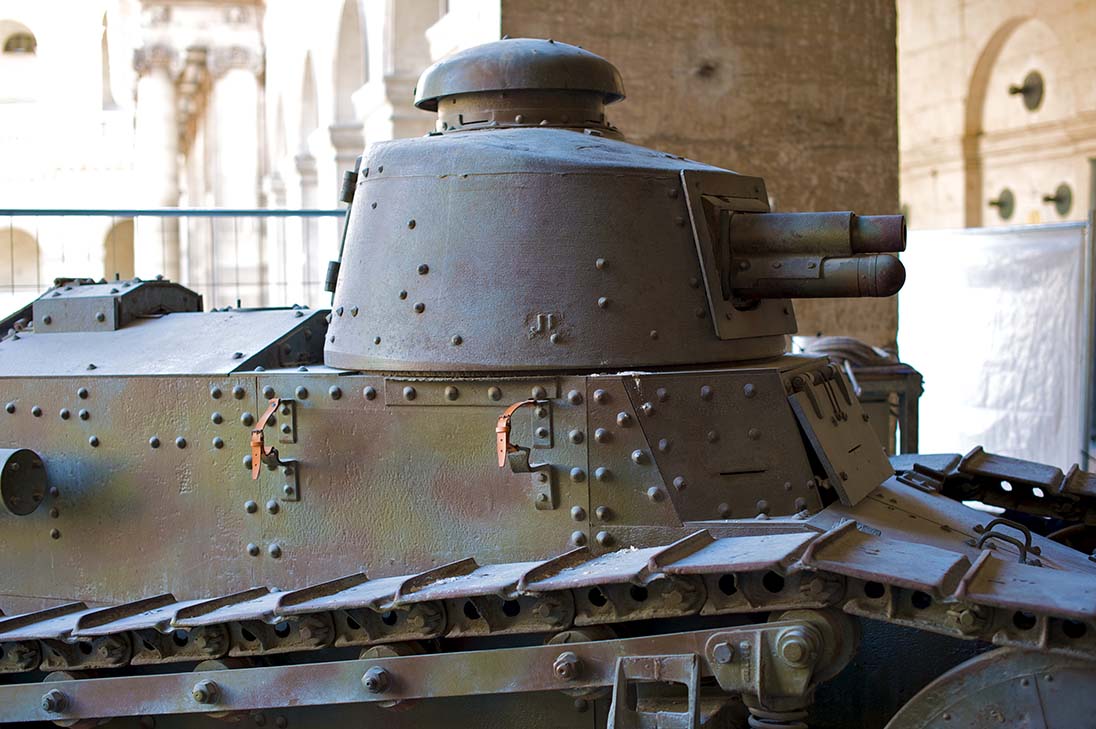
Turret designs for AFVs have seen a sustained evolution over the past decade as systems related to situational awareness have improved, in part due to better electronic designs and ever improving sensors. With this evolution has come a long-awaited rethink concerning the necessity of having crewmen within the turret itself, a precedent that was set and long adhered to with few exceptions since the birth of Louis Renault’s FT back in 1917. While the rotating turret was not a completely new idea at the time, having been tested on the British prototype tank known as Little Willie, the FT would be the first mass-produced tank to utilise such a turret design. After over a century, the basic concept of a fully-rotating turret centred around a main armament is still an effective means of integrating an armament system onto a large variety of AFVs.
Returning to contemporary times, turrets themselves now come in all types of different configurations. One of the more interesting industrial trends since the turn of the millennium has been the divergence of responsibility for platform and turret design. While certain states have at times chosen their platform and turret individually, this has gradually become the standard procedure for vehicles such as armoured personnel carriers (APCs) and infantry fighting vehicles (IFVs). This in turn has seen the emergence of a dozen or so companies who focus on standalone turret designs that are advertised to fit onto a wide variety of platforms, so long as the latter can sustain the necessary size and weight requirements.
With the large variety of standalone turrets available on the market today, a key trend in contemporary turret design is the capability for some turrets to be operated remotely, otherwise known as uncrewed or unmanned turrets. These are turrets that can be integrated with the same sensor or weapon suites as a crewed turret, but do not require crewmembers to be seated within the bounds of the turret – instead allowing them to be stationed elsewhere on a vehicle or even stationed externally from the entire platform itself as is the case for unmanned ground vehicles (UGVs).
This article will examine turrets and weapon stations divided by their primary armament class, taking a sample from each class, and comparing their advantages and disadvantages in relations to their crewed or uncrewed capability when present.
Small-calibre weapon stations
For turrets that are designed to house armaments that typically vary from small-arms calibres (5.56 mm and 7.62 mm) up to 14.5 mm heavy machine guns (HMGs) or 40 mm automatic grenade launchers (AGLs), a long-range engagement against an armoured target is not going to be task expected of such armament. Consequently, for vehicles that are not expected to be front-line combat vehicles, it may be financially prudent to equip such vehicles with either crewed weapon stations or remote weapon stations (RWSs). Though not turrets, weapon stations have taken over roles formally given to small turrets that housed relatively small and light armaments.

At its most fundamental, the protected weapon station can offer an affordable platform to house a single weapon and provide unrestricted situational awareness reliant on the human senses. A recent example of such a turret is the Objective Commander’s Weapon Station (OCWS) that is to be equipped onto all five variants of the US Army’s Armored Multi-Purpose Vehicle (AMPV) family. The protected open-top design sees the combination of opaque armoured material as well as protected glass. This allows the operator to peer above the protected sides of the turret when safe, and when in combat, operate the armament and retain some situational awareness by using the direct vision ports placed on all faces of the turret. While a simple design in concept, advances can be made by focusing on the materials used in the protection of such turrets. Despite not being stated for the OCWS, it would be reasonable to assume such a turret would be able to defeat small arms fire up to around 7.62 mm, allowing such a turret to operate in areas where the enemy is not expected to possess heavy weaponry.
The inherent weakness of such a design is its protection – the operator will be exposed to varying degrees, when using the weapon station. Whilst simultaneously a weakness, the ability for an operator to get a true view of their surroundings is also an advantage that is nearly impossible to fully replicate on uncrewed stations. The simplicity of such a crewed station due to the lack of any optoelectronic suite would also make it a cheaper product to equip a vehicle with, though importantly not necessarily lighter, which would depend on the weight of the ballistic protection used.

One argument in favour for utilising an RWS in place of something such as the OCWS would be for increased operator protection, the inclusion of more than one armament system, and possibly greater accuracy through automation of the target engagement process. A comparable uncrewed product to the OCWS could be Kongsberg’s Protector RS4.
The Kongsberg Protector RS4 is a good representative example of a ‘typical’ RWS, being one of the most popular choices on the market. It typically houses a 12.7 mm M2 Browing, though it can also house a 7.62 mm machine gun or even a 40 mm AGL. For the M2, the RWS can fit one standard box of 12.7 mm ammunition, consisting of 100 rounds. The RWS can rotate 360° in azimuth at a rotational speed of 90°/s, while its elevation range is between -20° and +60°, with an elevation speed of 70°/s. The RS4’s most valuable component is the optoelectronic suite, with both day and night (typically thermal) channels, and a laser range finder. Additionally, an anti-tank guided missile (ATGM) can be fitted as an option for longer-range engagements against armoured targets.
When compared to something like the OCWS, the RS4 would present greater lethality, with more flexibility in the armament fitted during the procurement stage, with the option to change the latter in the future. The main advantage would be for the operator to be located within the protected confines of the host platform, so as to not risk external exposure during combat. The optoelectronic suite also allows for operations at night, whereas an operator of a crewed weapon station would require infantry night vision equipment and tracer ammunition.
An RWS is highly automated, with the optoelectronic suite feeding into a fire-control system (FCS) that may use image recognition algorithms to recognise potential targets while a laser range finder can range targets near-instantaneously and automatically adjust the point of aim via a ballistic computer. Naturally, this level of automation comes with a much higher unit cost per system. Additionally, a survivability drawback is the necessity of reloading the armament system externally, which would need an operator to leave the armoured protection of the platform. This is particularly pressing when larger armaments can have quite limited rounds per munitions box.
Medium-calibre turrets
The market for medium-calibre turrets has moved at pace towards uncrewed designs. It is unclear if this is an industrial trend or rather something emanating from customer demands. Yet, differences still linger in procurement with some opting for uncrewed designs, while others may choose to remain with crewed designs.
One such option for a crewed medium-calibre turret design would be Elbit Systems’ MT30 turret, the crewed sibling to the uncrewed UT30 Mk2. As is now the standard for modern turret design, the turret hosts a plethora of sensors and subsystems. The turret is usually marketed with and is so far sold with the 30×173 mm Mk44 Bushmaster II cannon, although with competition in the turret market being fierce, most manufacturers would be open to hosting a variety of cannon types. The MT30 can host both fundamental survivability assets such as smoke grenade dischargers and can also integrate laser warning receivers (LWRs) such as Elbit’s ELAWS. The FCS and associated optical suite are also produced in-house. One of the MT30 key marketing points is the ability to host an active protection system, such as Iron Fist or Trophy.
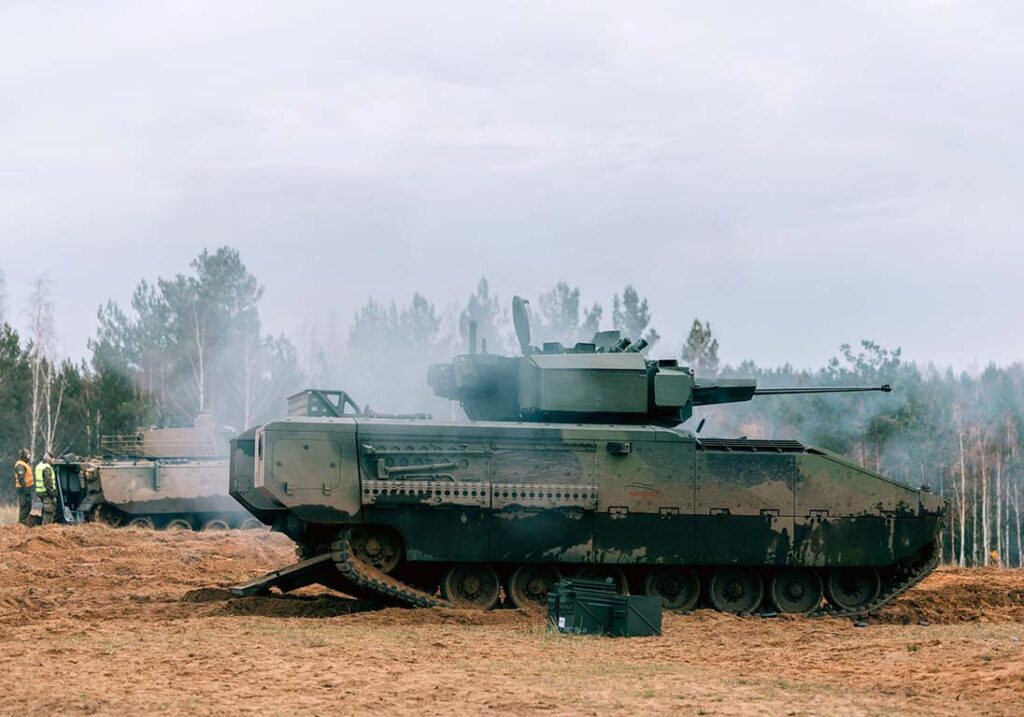
The MT30 turret has seen success over 2025, being utilised on a General Dynamics European Land Systems-Santa Bárbara Sistemas’ ASCOD 2 platform, which won a contract in Latvia for the delivery of an initial batch of 42 platforms. Elbit has since announced a USD 100 million contract to supply the UT30 Mk2 to an unknown NATO user of the ASCOD, with the primary culprit being Latvia, though this would suggest the Latvians have decided to use the uncrewed UT30 Mk2 variant rather than the crewed MT30 variant of the turret, which was used during trials. Another suspicion is whether Latvia will also opt into Elbit’s Iron Fist APS, with such an idea coming from a post shared in January 2025 on X by Latvian Defence Minister Andris Spruds. The post showed a scale model of an ASCOD 2 with the crewed MT30 turret (hinted through the presence of a commander’s hatch – a feature necessary for a crewed turret) with Iron Fist launchers. It remains to be seen if the option of a turret-integrated APS is chosen by the Latvians.
The UT30 Mk2 design was also evaluated for Spain’s Dragón 8×8 programme, alongside Leonardo’s HITFIST turret. However, Spain ended up opting for Escribano Mechanical & Engineering Group’s (EM&E’s) Guardian 30 turret. This is set to arm the most common variant of the Spanish VCR Dragón family, the VCI, with the wheeled platform based on the GDELS-MOWAG Piranha V design. The VCI’s Guardian 30 is armed with a 30×173 mm Mk44 Stretch Bushmaster II and a pair of Spike LR2 ATGMs housed in a retractable pod. The turret’s Apolo optoelectronic sights are developed by Escribano, while the FCS also has additional sensors including acoustic and meteorological sensors. It also comes with some passive protection systems, including LWRs and up to 12 smoke grenade dischargers. The turret, being uncrewed and also located on the roof of a platform (with no intrusion into the platform) means that the commander and gunner are placed within armoured protection. As such, a platform with such a turret could take advantage of hull-down positions, where the hull is obscured from enemy view and only the turret is exposed for reconnaissance and target engagement, to avoid placing the crew in direct danger. EM&E have also offered the turret to customers in 30×165 mm for customers accustomed to Soviet-era standard ammunition, with the turret having been trialled on the Arslon 8×8 APC being developed in Uzbekistan.
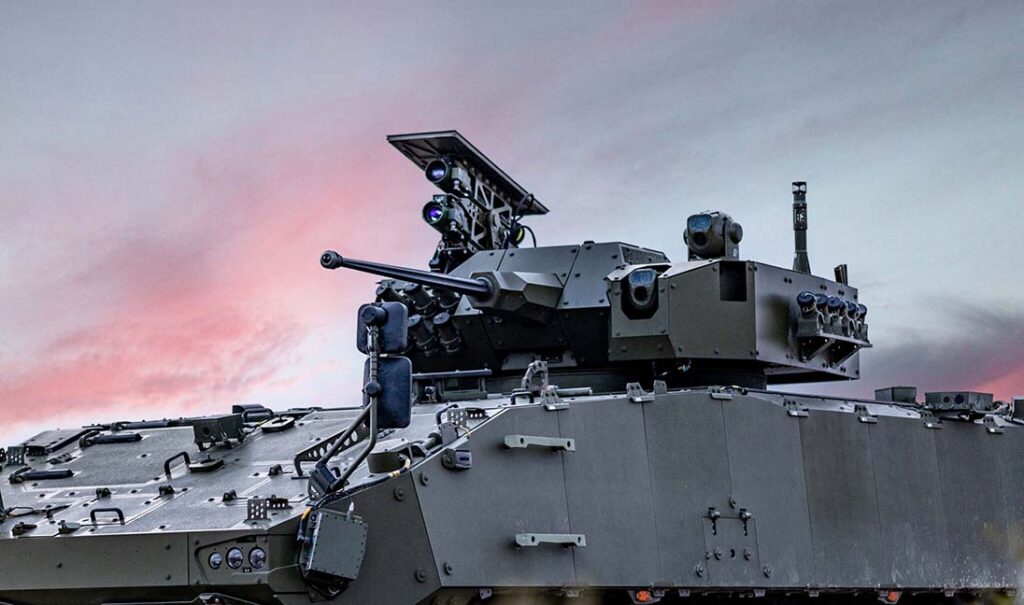
The aforementioned turret designs are marketed for the same market segment – use on wheeled and tracked infantry fighting vehicles (IFVs). When comparing both solutions, parallels can be drawn with the aforementioned crewed weapon stations and RWSs. The uncrewed Guardian 30 allows the crew to operate from under armour in the platform, but with the drawback that the main armament is understood to require external reloading (though it should be noted that some modern turrets do allow for reloading under armour). While such an issue is lacking for the crewed MT30, in comparison to the Guardian 30 it has a greater visual cross section from all arcs in the exterior, despite being armed with the same types and quantity of armament. This is a consequence of needing sufficient internal volume within the MT30 to house a crew of two.
In terms of design, and consequently cost, uncrewed turrets possess a distinct advantage: they do not require as much internal volume in the form of a turret basket within which crew would typically sit. Removing the need to accommodate humans eliminates the substantial ergonomic constraints that shape crewed turret designs. This reduction in required internal volume has substantial benefits. A turret of smaller volume can achieve a given ballistic protection level with less armour mass, whereas a crewed turret protected to the same standard must inevitably be heavier simply because there is a larger surface area to protect. This also means that for a fixed weight allocation, an uncrewed turret may actually be protected to a higher standard, as armour can be concentrated around a smaller, more compact structure. This represents a weight saving which, if required, could be put toward greater armouring of the hull, where the crew (the single the most valuable part of any platform) are concentrated. The question of vulnerability and the ease of scoring a mission kill on less-protected unmanned turrets remains legitimate, but it should not be assumed that crewed turrets on APCs and IFVs are uniformly better protected; in practice, they often are not. Instead, the central trade-off concerns volume, armour distribution and weight efficiency, all of which broadly favour uncrewed designs.
Having said that, doctrinal and operational preferences of users still play a decisive role in the choice between crewed or uncrewed turrets. For roles such as peacekeeping or low-intensity conflicts, a crewed turret may be preferred, for instance, for scenarios where a crew may be required to interact with a civilian population fairly regularly, or where reliable and flexible close-in situational awareness is needed, such as when looking for hidden improvised explosive devices (IEDs). Crewed turrets can also be more useful when manoeuvring through complex terrain such as forests, as the commander can more easily observe clearances between the vehicle and various terrain obstacles. Indeed, when the crew are not ‘buttoned up’, peering out above a hatch is often much faster and more convenient than flicking between several cameras on a screen. However, an uncrewed turret would typically provide greater crew protection at a given weight, and often presents a smaller profile.
Future outlook: Large-calibre turrets
While the choice for standalone product offerings for medium-calibre turrets are exhaustive, large-calibre turrets as standalone products are relatively rare. In Europe, the two main products that exist in this segment are the John Cockerill 3105 and the Leonardo HITFACT II – both of which are crewed only. One particular reason for this is the relative difficulty of isolating a roof-mounted turret while accommodating a large-calibre gun that requires ample room for elevation and recoil.

The John Cockerill 3105 is a crewed two-man turret built around an in-house 105 mm rifled gun. It uses an autoloader that stores between 12 to 16 rounds. The 3105 to date has only seen commercial success through the Harimau fire support vehicle for Indonesia and the LAV 700 assault gun variant for Saudi Arabia. There are signs it may see some success in the near future, with work to integrate the 3105 onto the Leopard 1A5BE having continued since the initial unveiling at Eurosatory 2022, with recent photographs from testing in August 2025 showcasing the 3105 sitting lower onto the hull with the exposed turret ring being less pronounced than previous iterations. It has also been integrated into India’s ongoing Zorawar medium tank project.
Offering a large-calibre gun in an uncrewed turret presents a major engineering challenge. This is because the gun’s breech, recoil assembly and autoloader each require substantial internal volume that cannot be eliminated simply by removing the crewmen. A 105 mm gun has a long recoil stroke and a large breech that must move freely during elevation and firing. These components are physically too large to be contained entirely above the hull roof without creating a turret that is excessively tall, so engineers typically need to extend parts of the mechanism down into the platform through the turret ring, which would prevent the physical separation between operators in the hull and the turret, which is in itself the fundamental advantage with uncrewed turrets.
One example of solving this issue was demonstrated by KNDS with the Leopard 2A-RC 3.0 at Eurosatory 2024, where the company managed to integrate a 120 mm smoothbore gun into an uncrewed turret without requiring a turret basket to intrude into the hull. This enables the crew to sit in a protected side-by-side configuration within the hull, isolated from the turret. The solution uses a double-trunnion system: while conventional crewed turrets rely on a single trunnion as the gun’s point of rotation, the double trunnion raises this rotation point, allowing the gun to elevate and depress without the breech dropping into the platform’s interior. Engineering challenges like these remain one of the limiting factors behind why large-calibre uncrewed turrets are still largely at the developmental stage, but as KNDS have shown, solutions will prevail to improve the prospects of such turrets in the near future.
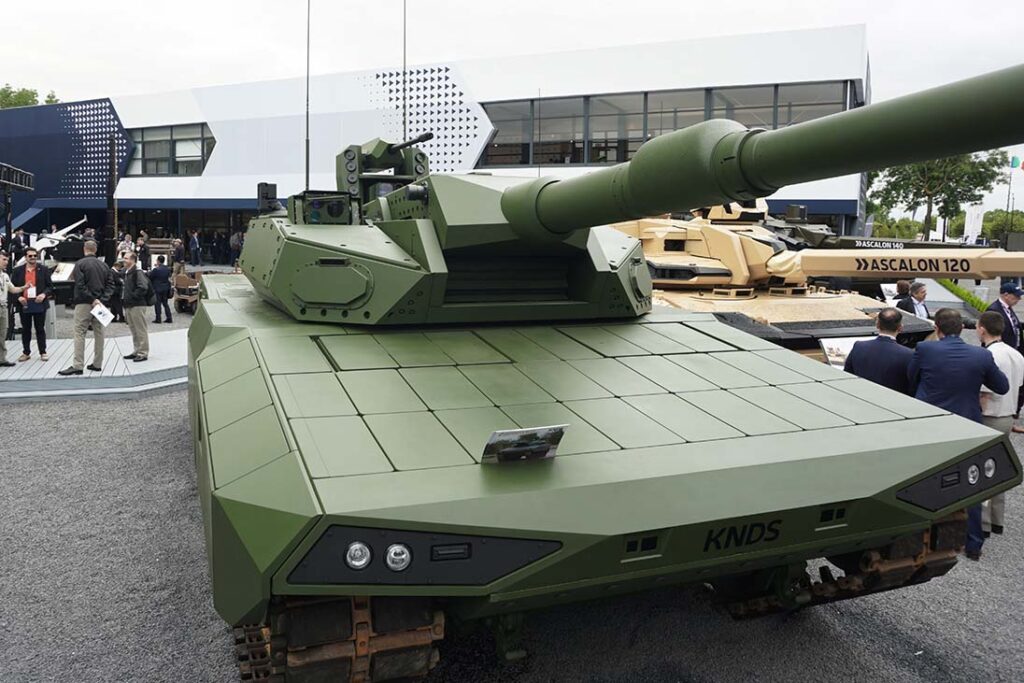
While many comparisons between crewed and uncrewed turrets apply equally to large-calibre systems, one notable advantage of an uncrewed turret in this context is the ability to shift much of the turret’s mass – particularly the crew and their protective armour – down into the hull, significantly lowering the platform’s overall centre of mass. This can translate into improved mobility, especially for wheeled vehicles, as a lower centre of mass reduces the risk of rollover and enhances stability when firing at high angles or when engaging targets perpendicular to the platform’s forward axis.
Closing thoughts
Uncrewed turrets appear set to become the default in the long term, driven by advances in situational awareness, increasing automation, and a steadily more lethal low-altitude threat environment – as seen with the rise of first-person view (FPV) drones in Ukraine. Crewed turrets, however, will retain a place in the market, offering lower-cost solutions with reduced automation and supporting doctrines that continue to value hatch access and unmediated situational awareness for vehicle commanders. Looking ahead, uncrewed turrets are likely to serve as stepping stones towards more sophisticated uncrewed platforms, even as operational autonomy remains technologically limited and autonomous armed engagement continues to raise ethical and policy concerns.
Chris Mulvihill