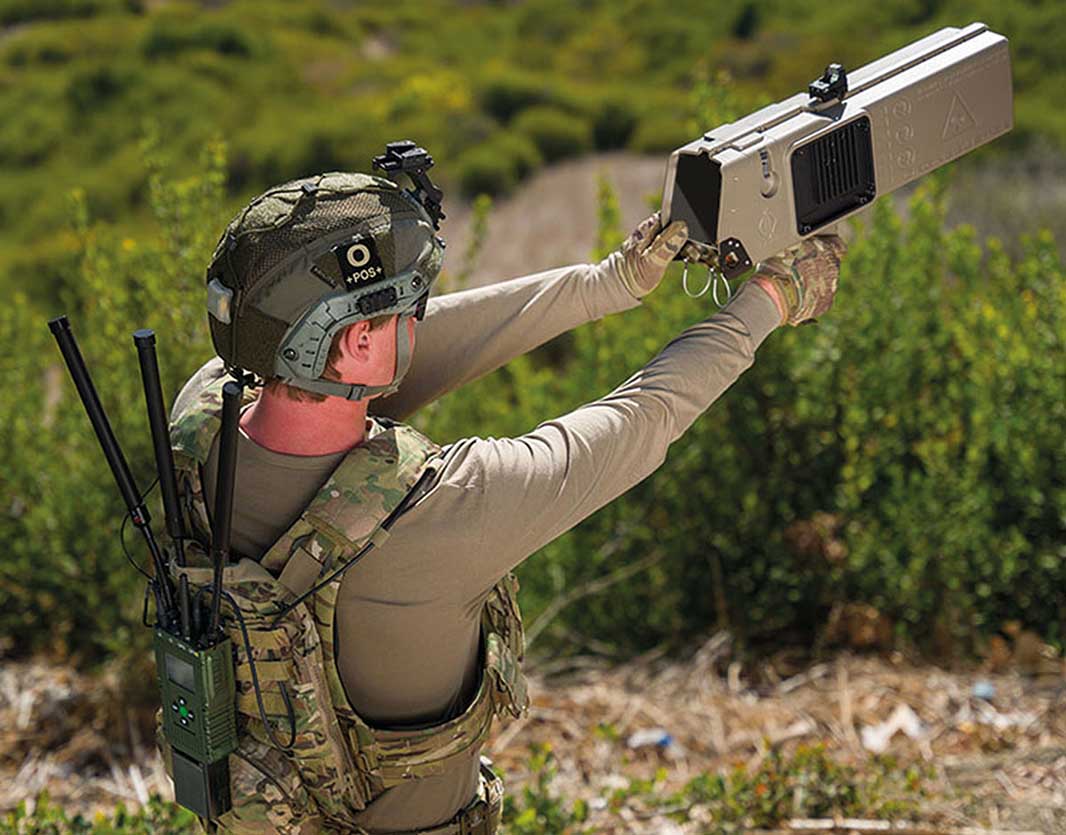
Recent and ongoing conflicts highlight the rapidly growing threat posed by unmanned aerial vehicles (UAVs) to dismounted infantry. A variety of kinetic and non-kinetic countermeasures are being deployed in response. Various factors impact the infantry-based counter-drone mission. On the one hand, the UAVs most frequently deployed against dismounted personnel are generally small and light, and not particularly robust or shielded, making them comparatively vulnerable to kinetic or electromagnetic disruption. On the other hand, their small size and generally low-altitude approach provide them with a minimal visual and acoustic signature and considerable agility; this tends to delay detection and minimise a defender’s reaction time. Early detection and classification thus become the infantry’s first line of defence. A layered defensive capability is also essential for engaging drones at varying range.
Detection and Electronic Countermeasures
Lightweight detection systems are frequently integrated with electronic warfare (EW) countermeasures in order to enable an immediate response before the drones close with the infantry unit. Some detectors are carried in backpacks and set up in the field, while others are small enough to be worn on the soldier’s body, enabling true on-the-go surveillance.
Danish company MyDefence Soldier Kit currently stands out as one of the most advanced wearable systems. It consists of two main elements – the Wingman detector (coupled with a wideband XF antenna) and the Pitbull jammer. The circa 2.5 kg system is worn on the plate carrier or vest without restricting movement.
The detector employs passive radio frequency (RF) sensing, enabling constant monitoring without further operator attention. While the baseline internal antenna monitors only a few frequency bands and permits 90° horizontal and vertical surveillance, the attachment of the wideband antenna expands omni-directional 360° coverage to the complete 200 MHz–6 GHz spectrum. Wingman alerts the wearer of a detection, and automatically relays sensor data to the kit’s jammer, enabling the fastest response when threats are detected. The Pitbull can be set to either manual mode, permitting the wearer to activate countermeasures, or to automatic mode. Interdiction can target GPS signals as well as RF frequencies to disable both autonomous and remote-controlled drones.

Additionally, the Soldier Kit can integrate an optional ATAK plugin with an embedded RF spectrum analyser. Sensor data can be shared in real time with other units, enhancing blue-force situational awareness and supporting coordinated operations.
In June 2025, the US Army announced the award of a USD 26 million contract to MyDefence to supply 485 mobile counter-UAV (C-UAV) kits. The contract is the largest in the Danish firm’s history. The hardware is expected to be distributed to US Army Transformation- in-Contact units in Europe (where it has already been tested) and elsewhere for operational evaluation, which could lead to larger procurement orders if the systems are deemed highly effective.
At AFCEA 2025, Elbit presented the newest iteration of the ReDrone C-UAV system. Unlike the earlier variants of ReDrone, the new Man-portable Detection and Jamming System configuration is only slightly larger and heavier than a hand-held radio. It is specifically designed to be carried by a single soldier and operated automatically while on the march. It is available in two options. The Portable Drone Detection System (PDS) device is a pure detection system scanning the 400 MHz to 6000 MHz with 360° coverage. The Portable Drone Detection and Jamming Unified System (PDJS) combines the PDS with a radio-frequency jammer effective along the system’s full detection spectrum. The system scans continuously and alerts the wearer when RF signals are detected. The jammer can be set for manual or automatic operation, and can form a protective electromagnetic bubble of up to 1,000 m diameter over the entire infantry unit. Prolonged jamming is possible on the march, at the cost of battery life. Batteries can be easily replaced in the field. The obvious drawback of this system is that it cannot defend against fibre-optic guided drones.
Not all detection systems monitor the radiofrequency spectrum. The Osprey cUAS system developed by Oregon-based Osprey cUAS Inc. combines EO/IR, acoustic and SWIR (short-wave infrared) sensors. It can detect all types of UAV including fibre-optic guided units. The compact system weighs less than 4 kg and is designed for deployment at the squad level. It is not a wearable system, and must be set up on a tripod or other support to operate. Setup can be accomplished by a single soldier within five minutes. While the firm does not provide specifics, it states that the device can seamlessly integrate and exchange sensor data with ATAK and C2 networks as well as with active countermeasure systems. Specifically, the system monitors for acoustic contacts across a 360° omnidirectional spectrum.
When a contact is detected, the visual sensors slew toward the coordinates for confirmation. AI-assisted analysis of sensor data classifies the target and performs 3D tracking (range, direction, altitude). Results are transmitted to end users and countermeasure systems in real time. While Osprey cUAS is still at the TRL 4/5 stage, the firm plans TRL-5 pilot deployments and partner integrations in Q1–Q2 of 2026.
Hand-Held RF Weapons
In addition to body-worn or tripod-mounted RF Jammers, numerous hand-held EW solutions are also in use. While microwave and laser systems remain too power hungry and bulky for dedicated infantry applications, roughly rifle-sized RF weapons are fully portable and easily wielded. They can be brought to bear quickly and are intuitive for trained infantry to operate, with some weapons requiring only five minutes of instruction.
The DroneBuster RF weapon marketed by DZYNE detects and disrupts drones across the 400 MHz–6 GHz spectrum. The 55 cm long, 2.65 kg device is equipped with a pistol grip and can be fired with one hand. Picatinny rails permit attaching various accessories including a selection of optical sights and a laser rangefinder. Unlike many handheld electromagnetic weapons, the DroneBuster’s capabilities are not restricted to RF jamming. According to the manufacturer, it is the only US-produced handheld counter-small- USV with optional PNT (Position, Navigation, and Timing) Attack (GNSS spoofing) ability. This allows the DroneBuster operator to feed the drone false GPS coordinates, mislead its navigation system, and cause it to drift, land, or lose autonomous guidance. This is especially useful when confronting autonomous drones on pre-programmed waypoint missions.
More than 2,500 units have been deployed in 50 countries worldwide to date, with a large portion being used by the US Army. The latest iteration, the DroneBuster Block 4, was introduced in 2025 as a ‘next-generation’ countermeasure featuring enhanced transmission power, wideband coverage, support for jamming all modern GNSS satellite constellations, and is effective against both single drones and swarms. The Block 4 is also available in a dedicated DroneBuster 4-EU variant designed to add jamming for the European short-range device band. Both variants can seamlessly integrate with the firm’s proprietary Detect, Track, Identify (DTI) device which can be handheld or worn on the soldier’s vest. The DTI provides omnidirectional wideband detection at up to 7 km distance. Tracking and target identification data is presented on the LCD display or through optional interface with a TAK (Tactical Assault Kit) device.
The Australian firm DroneShield produces a range of globally marketed C-UAV systems including the DroneGun Mk4 and the longer-range variant DroneGun Tactical. The DroneGun Mk4, released in 2023, is described as an ultra-portable handheld countermeasure. The 3.37 kg weapon is equipped with a pistol grip and fired with one hand. The weapon activates within three seconds, and comes with a safety switch to prevent accidental discharge. The integrated battery supports one hour of aggregate operational time per charge, although batteries can also be exchanged quickly in the field. The weapon disrupts control, video feed, and navigation signals, as well as satellite navigation signals. Top and bottom Picatinny rails facilitate customisation with additional elements. While DroneShield does not publish operational range, the Mk4 is generally believed to be effective out to 500–1,000 m.
The firm’s DroneGun Tactical is generally attributed with double the range of the Mk4. The larger, bulkier Tactical weighs 7.3 kg, due largely to the more powerful batteries (including the carrying case, the full system weighs 20 kg, versus 12 kg for the cased Mk4). Aggregate operating time is two hours per battery charge.

Fire Control Systems for Assault Rifles
While standard assault rifles and sights are not well suited for acquiring, tracking and engaging fast and agile small UAVs, special automated tracking and fire control devices can now significantly improve the infantry’s odds of downing drones with their service rifles. The SMASH family of AI-assisted fire control systems (FCS) is currently the global leader in this field (the designation is not an acronym but the contraction of Israeli manufacturer’s name, SMArt SHooter). The devices, which are mounted on the weapon’s Picatinny rail, incorporate a red-dot reflex sight, digital stabilisation, onboard computer and image processor. They provide automatic target acquisition and tracking. The FCS performs a real-time calculation of the optimal release time for the bullet, and prevent the rifle from firing until the FCS’s reticle is truly aligned for a hit (‘lock and launch’ trigger interlock). The system is designed to intercept micro- and mini-drones with a single precision shot during daylight or nighttime operations. According to SmartShooter, minimal training is required.
The SMASH 2000L (‘Light’), marketed since 2021, improves on the original SMASH 2000 fire control system (FCS). Optimised for dismounted infantry, it weighs circa 740 g, or 20–30% less than the earlier variant (depending on configuration); is reduced in size for easier handling; and has improved battery efficiency (72 hours or 3,600 assisted shots). According to SmartShooter, the targeting algorithms enable soldiers to track and hit even very small, highspeed UAVs at distances up to 250 m. The SMASH 4X, developed for sharpshooters and designated marksmen (including dedicated C-UAV shooters), takes the capabilities matrix a step further. It has an improved electro-optical sensor suite and integrates 4× optical magnification to achieve better long-range target recognition and enhanced tracking for Group 1 and 2 UAVs at greater distances. It also features a more powerful onboard processor and can be equipped with optional networking and data sharing features as well as a laser range finder. The 4X, which was introduced in 2022, uses the same battery configuration as the 2000L. While SmartShooter does not provide weight figures, the enhanced elements are likely to increase the 4X to circa 1–1.2 kg.

Combat Shotguns
Shotguns have proven an effective tool against UAVs at close range. In practice they are most useful against drones which have evaded first-line defences. While standard combat shotguns and shells can be used, specialised firearms and munitions provide a greater chance of intercept.
The Benelli M4 A.I. Drone Guardian shotgun (top) and the Fabarms STF/12. (Originals:
Benelli Defense and Fabarms/Composite: S.E. Dean)
Benelli Defense introduced the M4 A.I. Drone Guardian 18.5” shotgun during the Enforce Tac expo in March 2025. Derived from the Benelli M4 shotgun, the semiautomatic 12-gauge counter-UAV weapon is chambered for 3” magnum shells. For once, the acronym A.I. does not stand for artificial intelligence but for advanced impact. This refers to patented improvements made to the barrel, including a larger and longer cone which in turn improves effective range, velocity and destructive impact. Benelli cites an optimal engagement range out to 50 m, and a borderline capability out to 100 m. The weapon comes with a Picatinny rail and features a 355 Ghost Ring rear sight with diopter with adjustable windage and elevation and protective side lugs. A 26” barrel and a Steiner red-dot MPS are available.

The preferred munition is the Norma AD-LER (anti-drone long effective range) which packs 350 2.7 mm diameter tungsten buckshot and achieves up to 100 m effective range. According to test data cited by Benelli, up to 25 pellets struck mini-UAV sized targets at 75 m distance, considerably more than the three pellets often considered sufficient to disable a small drone.
Fabarm’s STF/12 Compact XL Range 22” is another shotgun designed specifically for CUAV roles. The Italian-made 12-gauge, 3-inch chamber (12/76) pump-gun features the Tribore HP 22” XL barrel that tapers from 18.7 mm to 18.4 mm. This configuration helps achieve higher muzzle velocity, tighter patterns, and greater effective range. Like the Benelli M4, the STF/12 can accommodate tungsten carbide anti drone loads such as Norma’s AD-LER. Fabarm cites destruction of drone-sized clay targets at ranges up to 100 m during testing.
In addition to destructive rounds, shotguns can also fire specialized munitions to capture and force down the UAV. A prime example is the ALS12SKY-MI5, also referred to as SkyNet, manufactured by Amtec Less Lethal Systems (ALS). Once fired, the 12-gauge round deploys five fibre tethers, each of which is topped by a Zuerillium alloy anchor. Centrifugal force draws these weights out uniformly so that the fibre tethers form a 1.5- metre-wide capture net. On impact, the net enfolds the drone, incapacitating the propellers and forcing it down. The Mi-5 shell can be fired from pump or semi-automatic shotguns with a 3” chamber and a barrel length of 18” or greater, utilising a cylinder, improved cylinder, or rifled choke.
Ground-Launched Rucksack-Portable Interceptors
Recent developments enable dismounted infantry to launch airborne interceptors against enemy drones. In August 2025, paratroopers from the US Army’s 173rd Airborne Brigade’s innovation team achieved the US military’s first documented drone-on-drone intercept using an armed UAV. The test, conducted at Fort Rucker, Alabama, employed a SkyRaider quadcopter developed by Aeryon Defense USA (a FLIR Systems subsidiary). A Claymore mine was attached to the bottom of the quadcopter, which was launched to intercept a fixed wing intruder drone. Both UAVs were remote controlled and engaged in what Army observers called a ‘dogfight’ until the interceptor achieved an optimal position and the operator detonated the payload. The target was destroyed while the interceptor was retrieved intact. While the concept remains, for the moment, in the evaluation stage, the successful use of the 80 cm wide, 4.5 kg light UAV opens significant new options for squad-level infantry counter-drone operations. “With the right kit, paratroopers will be able to utilize a low-cost system with pre-existing munitions to execute a wide variety of mission tasks – and have the power to protect their unit from an endemic threat,” said team leader 1st Lt. Francesco La Torre.

German startup E-Wolf & Warg Drones presented its Drone Hammer C-UAV Missile at the May 2025 AFCEA Expo. Drone Hammer is a miniaturised, ground-launched solid fuel rocket specifically optimised for dismounted infantry to use in the counter drone role. While the 50- cm-long weapon can be prepared and launched by a single operator, targeting requires laser illumination of the target drone by an external source – in this case optimally by a second infantry soldier. Drone Hammer has a stated range in excess of 600 m, and approaches its target at 500 km/h. As it nears the drone, the warhead detonates a CO₂ canister, releasing submunitions which form a 10-m diameter cloud, ensuring target destruction. According to E-Wolf & Warg Drones, the Drone Hammer is currently at TRL 5. A new company, Skylance, is being formed to pursue the dedicated development programme through operational maturity. The firm estimates a unit price of EUR 2,500.
Project Flytrap
The Drone-Counterdrone arms race will continue and intensify. Increasing integration of AI into sensors, EW countermeasures, fire-control systems (FCS) and interceptors will enhance the accuracy and speed of detection and neutralisation. Another lesson that continues to be reinforced is that no single system can address the full spectrum of small UAV threats. This was proven again during Project Flytrap, a bilateral US-UK evaluation of infantry-suitable counter-drone systems conducted in four stages or ‘iterations’ between June and August 2025 in Germany and Poland.
The exercises validated a layered, multi sensor, multi-effector construct built around rapid adaptation and close soldier-engineer collaboration. The exercise consistently blended RF detection, jamming, smart optics, kinetic shooters, and drone on drone capabilities. Leaders from V Corps emphasised that the programme’s value lies not only in technology assessment but in accelerating transformation across NATO’s forward deployed land forces. Project Flytrap represents a pragmatic, soldier centred pathway toward layered C-UAV integration, blending technological innovation with incremental doctrinal change to meet the demands of the contemporary battlefield. Iteration 5.0 will build on lessons learned to date. It is scheduled for March–April 2026.
Sidney E. Dean
Author
Sidney E. Dean is a freelance writer and editor specialising in strategic studies, military technology and military history. He serves as North America correspondent for ESD and other Mittler Report Verlag publications.
Click here to read the latest issue of ESD.