Russia’s full-scale invasion of Ukraine in February 2022 was the largest armed conflict in Europe since World War II. It has changed – and is still changing – how we understand modern ground warfare. Classical NATO doctrines, developed during the Cold War before being skilled and tested in Middle Eastern conflicts, were based on the expectation of air superiority and fast-moving armoured forces. The war in Ukraine has shown that strong air defences and the widespread use of drones by both sides have made deep offensive operations difficult, resulting in a mostly static front line, except in areas where one side gains a temporary advantage.
At the same time, in modern warfare – which is often a confrontation of drones and technologies – infantry remains the basis of ground combat, since no technical system is yet capable of independently capturing and holding territory. It is infantry units that carry out the key tasks: assaulting and defending positions, clearing populated areas, and controlling territory. This can be described as ensuring the state’s real presence on the ground. Without the involvement of infantry, no ground operation can be considered complete. Thus, infantry – previously viewed by many as a supporting branch of the armed forces in the era of high-precision weapons – has once again become the central element in intense combat, albeit in a more technologically advanced form.
The Evolution of Ukrainian Armed Forces
Infantry in the War Against Russia, 2022–2025
From 2022 to 2026, the infantry of Ukraine’s Defence Forces underwent a rapid and profound transformation to adapt to a war of attrition against an adversary with superiority in artillery, aviation and manpower, while relying on limited resources and the accelerated introduction of new technologies, primarily unmanned aerial vehicles (UAVs). The transformation was so radical that, according to assessments by Ukrainian military personnel themselves, a soldier who joined the army in 2022 and, for some
reason, had a break from the war would have to undergo complete retraining by 2026 – both in terms of coordination with units band in the use of new systems such as drones, ground robotic platforms, and robotic observation posts.

During the initial stage of the full-scale invasion, Ukrainian infantry operated mainly according to traditional doctrines of territorial defence and combined-arms warfare. This involved urban combat in small units, holding populated areas, and organising defences in deeply layered positions. The lack of air superiority – due to limited aircraft and air defence capabilities – along with restricted counter-battery options, forced the infantry to adopt a decentralised command structure: platoons and squads often acted independently, relying on the initiative of junior commanders. Even at this stage, the flexibility and high adaptability of the Ukrainian infantry became clear, sharply contrasting with the highly centralised Russian units. At that time, the backbone of operations was formed by battalion tactical groups, where armoured vehicles played a key role as a means of manoeuvre, protection, and direct firepower. A typical offensive looked like this: deep reconnaissance, heavy artillery and rocket strikes, an armoured thrust, after which infantry – either mechanised or on foot – would complete the clearing and consolidation of captured positions. Assault units could number 10 to 40 soldiers. However, it is important to understand that such a number of fighters did not advance in a single dense line. Moreover, Ukrainian tactics at this time evolved towards greater dispersion. A single group often split into several subgroups – those entering trenches or buildings directly, a fire support group suppressing enemy positions, and a reserve group ready to organise defence or repel a possible counterattack while the first subgroup regrouped or evacuated the wounded.

The situation began to change dramatically in 2023. The widespread use of first-person view (FPV) drones by both sides caused catastrophic losses of armoured vehicles, often even during the advance to start positions. In addition, the number of continuously operating reconnaissance UAVs increased significantly. The reconnaissance network began functioning in real time, sharply reducing the time between detecting a target and striking it. As a result, in many operations, a sizeable percentage of tanks and infantry fighting vehicles (IFVs) were destroyed by the enemy before even entering direct contact, making classic mechanised assaults extremely costly and risky. Assault group sizes shrank dramatically, down to 8–14 soldiers. Combat formations consequently took the form of a “cloud” of small groups. For example, a platoon could be spread over an area previously occupied by a company or even a battalion. This made high-precision strikes economically inefficient – for instance, against a group of three fighters.
A new phenomenon emerged: the so-called “drone wall,” a near-continuous engagement zone, with FPV drones equipped with delivery systems, and precision-guided artillery, extending 10 to 25 km deep. As a result, large-scale offensive operations gave way to local “nibbling” of positions, infiltration, and the accumulation of small groups in shallow enemy rear areas or in the grey zone. This minimised losses, though it also slowed the pace of advances. A challenge for the Ukrainian Armed Forces is that the Russian army actively uses similar tactics.
In 2024–2025, the primary source of a unit’s firepower was no longer small arms, grenade launchers, or anti-tank missile systems, but FPV drones, cargo drones, and ground robotic platforms. By 2025, an assault group could be comprised of between 5–9 infantry soldiers (carrying ammunition, assault troops, and engineers), 4–6 operators of various types of drones, and 1–3 operators of ground robotic platforms. The role of ordinary infantry changed dramatically. They began identifying and further scouting enemy positions, covering drone operators, marking and confirming targets, finishing off the enemy after drone strikes, and quickly consolidating captured positions. Unlike traditional artillery fire, drones eliminate specific enemy silhouettes and firing positions. Infantry only advances once the enemy’s fire systems are disrupted by precision strikes.
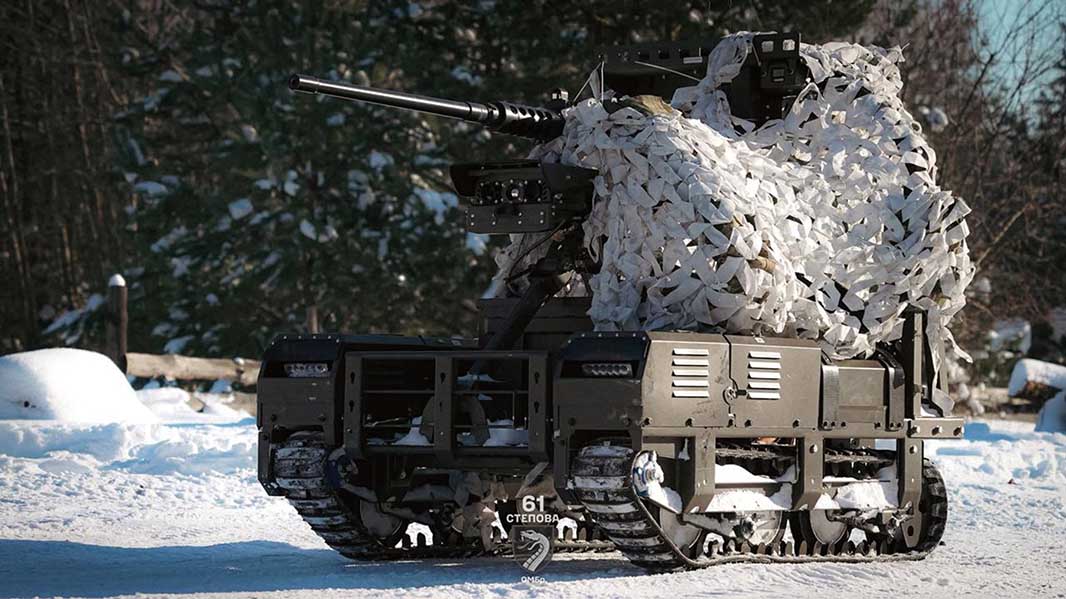
At the same time, so-called robotic strongpoints appeared as a technological response by the Ukrainian forces to manpower shortages and the high tempo of Russian offensives in certain areas. Unlike traditional strongpoints, where soldiers must be directly at the machine gun, in robotic strongpoints the firing positions are placed 50–500 m forward, while operators remain in protected locations controlling the fight via terminals. Thanks to these systems, positions could be held for 30 days or more, primarily by ground robots equipped with machine guns, thermal imaging cameras, and motion sensors. By early 2026, this concept was gradually moving from experimental testing to serial deployment, with the logical next step being “swarm” control, where one operator manages not a single turret but a network of firing positions. Ukrainian examples of such systems include Burya 2.0, Wolly and ShaBlia.
In addition to robotic platforms at command posts, cargo drones and unmanned ground vehicles (UGVs) began to be widely used in areas where roads were blocked by enemy fire. These systems deliver food, water, and ammunition to positions, allowing strongpoints to remain combat-capable. According to Ukrainian military sources, by 2025 around 90% of all supplies to the front line near Pokrovsk were delivered by UGVs.

As of early 2026, classical armoured assaults without the prior creation of a “drone corridor” are no longer used. The modern offensive scheme now looks as follows: deep drone-based attrition at a depth of 10–40 km, a simultaneous strike by a large number of FPV drones against identified targets, followed by infiltration and consolidation by small units in selected areas. It is clear that unmanned systems have radically changed the nature of combat for Ukrainian infantry. Russian forces are also actively employing fibre-optic drones, coordinated FPV swarm attacks, and ground-based unmanned platforms. However, Ukraine has outpaced its opponent in the speed of technological adoption and in integrating drones down to the lowest tactical level – squads and assault groups. This gap is now one of the reasons for the asymmetric effectiveness of Ukrainian infantry under conditions of limited manpower and material resources, as drones have effectively become the “eyes” and “artillery” directly available to the individual infantryman. At the same time, while Ukraine is ahead in the issue of technology integration, Russia is attempting to offset this by leveraging its superior resources to rapidly replicate and mass-produce systems that Ukraine was the first to test in real combat conditions.
As the Armed Forces of Ukraine are forced to counter various types of UAVs used by Russian forces and infiltration tactics by small infantry groups, adaptation of the front’s defensive line has come to play a major role, becoming a key element of territorial control under constant aerial surveillance. What exists now is no longer a continuous line of trenches, but rather a system of separate strongpoints, grey zones and specially prepared areas designed to destroy the enemy with drones. Between major defensive nodes there are often gaps – up to 1–3 km wide – not covered by a permanent infantry presence, but primarily by drones. If a small-sized Russian unit does manage to infiltrate such zones, efforts are made to detect and eliminate it as quickly as possible, before it has time to consolidate.
At the hottest axes of the Russian offensive, it is precisely the density of the “wall of drones” that remains the main factor slowing the advance of small enemy groups. This tactic has turned into a constant on-station presence of UAVs and the rapid rotation of operators. However, this same tactic contains its own vulnerability – both a shortage of drones and of skilled operators, which plays into Russia’s hands.
A painful problem at present is Russian fibre-optic-guided FPV drones with ranges of 20–60 km, which can bypass electronic warfare. To counter them, the Ukrainian Armed Forces are forced to employ a set of methods, such as camouflage and frequent positional changes, the construction of underground shelters with multiple exits, and the hunting of enemy UAV operators. Because of these challenges, the assessment of the usefulness of particular types of fortifications has also changed. If at the beginning of the full-scale war large strongpoints were built, now instead of large fortifications, smaller groups of trenches are constructed – the so-called “foxholes” – which minimise the effects of the enemy’s use of strike drones.
As a result, by early 2026, Ukraine’s defence has turned into a hybrid model, in which the main defensive nodes with infantry, mortars, and artillery hold key points, while all remaining space is controlled by drones. However, this system is highly dependent on maintaining a high density of drones and on rapid response to any infiltration. A decrease in drone density can lead to local breakthroughs and an expansion of grey zones.
Ukrainian Experience for NATO Forces
The experience of Ukrainian infantry in modern full-scale combat operations against the Russian army offers a number of important lessons for NATO armed forces. First, the use of traditional mechanised infantry tactics cannot withstand modern UAV-dominated combat without both the total dominance in the drone domain and prior creation of a “drone corridor”. Second, victory in a war of attrition, among other elements, depends on such critical factors as the mass production of inexpensive strike UAVs, the speed of introducing new counter-drone technologies, and the training of infantry soldiers as universal operators of drone systems.
NATO’s armed forces don’t have much time to undergo such a transformation. A dangerous mistake would be to preserve outdated approaches, hoping that classical warfare will become relevant again (with the use of large amounts of armoured vehicles and precision-guided weapons). Faced with the reality of the 2020s, such a war is virtually impossible without absolute dominance in the air and especially in the drone domain. Ukrainian experience shows that in modern warfare, victory belongs not to the side with more tanks, but to the one whose infantry adapts more quickly to technological changes and is more effectively integrated into a unified digital battlespace.
Alex Horobet
Author
Alex Horobets is the Ukraine correspondent and regular contributor to ESD. He focuses on geopolitics, modern warfare, defence industry developments. Horobets has written articles on defence and security issues for various media and think tanks in the US and Europe.
Click here to read the latest issue of ESD.