Minefields are one of the most effective battlefield obstacles, used to achieve a variety of tactical aims for those laying them, impeding an enemy’s mobility and speed of manoeuvre, to name but two. Faced with such barriers, overcoming them is no easy challenge.
With mobility and manoeuvre two of the most important capabilities contributing to success on today’s battlefields, the counter-mobility problem caused by minefields is one that requires solutions. Deliberate breaching is a huge undertaking, typically requiring a brigade-sized unit to conduct successfully with the right equipment, in the form of latest combat engineering vehicles and systems. Experiences from Ukraine, however, in latest Russian minefield tactics, give pause for thought. Consequently, a re-think by allied forces as how best to handle these battlefield developments, may well be needed.
This article, therefore, with a brief and simplified overview of minefields, looks at what’s happening in Ukraine, including recent US Army Intelligence analysis of the counter-mobility issue on the ground there, and rounds off with a brief look at some of the systems donated and supplied to the Ukrainian Armed Forces.
Setting the scene
It normally falls to military engineers to lay mines and create minefields of different kinds in line with orders from higher command and for a variety of possible tactical reasons, intentions, and hoped-for/calculated outcomes. Protective minefields, for example, might include using mines to help defend an installation of critical importance. Nuisance minefields might be laid to cause disruption, chaos, and delay. Fake or phoney minefields are a ruse most effective when encountered by an enemy already impacted and sensitised to the potential presence of mines, their fear and over-cautiousness resulting in the expending of valuable time and mine-clearing assets trying to breach and clear an area that’s already free of mines. Just as with a real minefield, formations of vehicles and troops are unnecessarily delayed and diverted and become vulnerable to incoming fire from the forces who prepared the deception in the first place. The tactical minefield, however, emplaced by a defending force to hold ground and retain a positional advantage, presents the biggest challenge to the mobility and manoeuvre of an advancing formation.
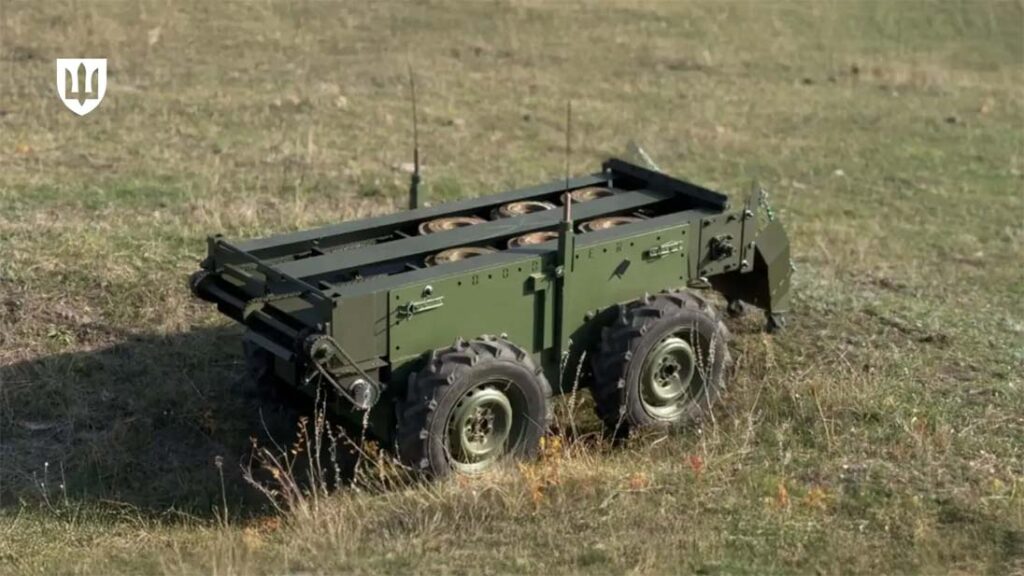
Such minefields are laid, initially, with sufficient time using anti-tank (AT)/anti-vehicle (AV) and perhaps off-route mines, as opposed to potentially being hastily replenished at a later date using scatterable anti-personnel (AP) mines, while under attack. A tactical minefield’s design and topography can be carefully planned, including as part of major defensive lines interlocking with other obstacle fortifications, such as dragon’s teeth. In the first instance, these minefields will impact the enemy primarily through area denial and movement manipulation. Minefield depth and width will be varied by the sappers laying them, who may also create an irregular outer edge (IOE) to the minefield, contoured to help achieve required tactical outcomes, or for other reasons such as a shortage of mines. Mines-per-square-metre density and the kinds of mines themselves, will also vary; they may be dug-in to a certain depth, and some may be laid on the surface, including by unmanned aerial vehicles (UAVs) or unmanned ground vehicles (UGVs), as used in Ukraine. While these few scene-setting lines are a vast oversimplification, it is how to deal with minefields, which is the question, as it has been since they entered warfare during WWI. Since then, a variety of different strategies, methods, tactics, and technological solutions for dealing with them have been developed, and these continue to evolve. Let’s now look at the situation on the ground in Ukraine, not only to highlight fresh and concerning developments in minefield tactics and design being used by Russia, but also to highlight some of the breaching systems supplied by Ukraine’s allies.
Changing approaches: Ukraine’s grim minefield challenge
On the battlefields of Ukraine, where, in some places, there are still mines left in the ground from WWII, minefields and mine warfare have been used extensively by both combatants in the current conflict. In a November 2024 report: ‘Russian Minefield Tactics Pose Challenge to Mobility’, by Richard Garcia and Colin Colley of the US Army Transformation and Training Command’s Operational Environment and Threat Intelligence Directorate, T2COM, and worth detailed consideration in the context of this article, the authors noted that minefields being laid by Russia since the 2022 full-scale invasion have become significantly larger and more challenging than at any time since the invasion of the Donbas and Crimea annexation in 2014. The authors expand their analysis of developments on the ground and present some implications and recommendations wholly pertinent to our discussions in this feature.
In the first instance, the report sets a terrible scene, stating that the extensive use of landmines by Russian Forces, different separatist groups, and the Ukrainian Armed Forces since 2022, has resulted in Ukraine having acquired the miserable accolade of the ‘most heavily mined country on Earth’, surpassing previous leaders in this regard, Afghanistan and Syria. Indeed, 11 out of 27 Ukrainian regions are now said to be contaminated with landmines. Of significant changes in minefield creation, Garcia and Colley state that in the late-2022 early-2023 timeframe, the depths and widths of Russian minefields and other defensive positions along the main axis of advance of Ukrainian Forces, (who were planning a counteroffensive at the time), increased. Whereas their minefields had initially been typically 100–200 m² in size, minefields of at least 500 m² became widespread along the front, with mines, themselves, often more densely laid over these greater areas – this was, however, at a time when mines were in more plentiful supply than at time of writing. Another overarching challenge for the Ukrainians highlighted in the intelligence report is Russia’s use of multiple types of domestically-made AP and AV mines, including new designs like the PTM-4M and POM-3 never previously encountered. At least 13 of each type of mine have been identified. However, the good news, in some ways, for the Ukrainians, is that domestic manufacturing capabilities have not been able to keep up with the demands of the battlefields, in turn leading the Russians to effect different approaches; one has been to create IOEs to their minefields, while others include laying mines less densely, and also mixing live AT mines with dummy mines, thereby creating ‘phoney minefields’.
Early in the conflict, Ukraine had limited mine-breaching engineering capabilities, and while this has improved through the donation, by several NATO Allies over the course of the war, of various breaching systems and vehicles, some older than others, challenges remain. When faced with Russia’s 500 m-deep minefields, even when using latest equipment, these present a formidable task, with the report suggesting that to breach just the mine obstacle would take around 1.5 hours. Considering the minefields are interwoven with the likes of tank ditches, dragon’s teeth, and more, a breach would, however, likely be much more “challenging and time-consuming” according to Garia and Colley’s report. With drones playing a huge part in this conflict, the authors also note that: “The persistent drone surveillance makes Ukrainian breaching elements vulnerable to detection and Russian artillery fire.” And while Ukraine’s breaching capabilities have improved since the first year of the war, the report notes that its much-heralded 2023 counteroffensive stalled, largely as a result of its forces’ “inability to breach” Russian minefields effectively at that time; along their three main counteroffensive axes they advanced around only 16 km as a result.

And very much in the context of this discussion, the Garcia and Colley underline a key lesson learned by the Russians – that by using enough mines, or the threat of mines, the mobility and manoeuvre of Ukrainian Forces in assault “can be slowed or even halted by defeating their breaching operations”. And this is where they suggested that in overcoming and solving this counter-mobility challenge, “the Ukrainian Army must modify its mine-clearing and breaching solution. For example, a better counter-UAS capability could provide Ukrainian forces more time to breach by disrupting Russian surveillance drones. However, the longer it takes the Ukrainian Army to develop an effective breaching strategy, the more time it gives the Russian Army to improve its defensive positions.”
A salutary message for the Ukrainians, indeed, though in the current phases of the conflict, breaching may not be their highest tactical or strategic priority. However, in conclusion, what Garcia and Colley develop from the minefield intel gathered in Ukraine, are implications they posit for the US Army and its training regimen – and these are equally important for all NATO members, now and in the future. They stated: “As minefields and other obstacles become more advanced, US Army manoeuvre units could emphasise training on breaching deep obstacles, targeting enemy engineer assets, and the OPFOR could simulate Russian obstacle tactics.”
Well, in contrast to how the US Army operates as a mobility-focused force, the Russian approach in Ukraine is one of attrition against the enemy rather than a focus on its mobility, which is where their use of minefields ends up forcing the opposition into gruelling, attritional contacts. The resulting implication and recommendation from Garcia and Colley is that US Army units may benefit from putting a “greater emphasis on training for breaching deep obstacles under constant observation and heavy indirect fire”.
In addition, the option of preventing large-scale minefield emplacement in the first place, is emphasised, an approach that can be undertaken by targeting mine-laying equipment and units and disrupting their chances of laying these obstacles in the first place. Again, Garcia and Colley stress the importance of incorporating such new approaches into training, suggesting a hypothetical military exercise in which an OPFOR could adopt minelaying and obstacle tactics similar to Russia’s. They could create obstacle belts, which force friendly US ground forces, whose key strength is their mobility, to overcome counter-mobility obstacles, including the kinds of deep minefields placed by the Russians, and being over-watched by persistent drone surveillance and under constant threat from artillery fire.
The report concludes by reinforcing the advantages that can be assured through the targeting of enemy engineer minelaying assets: maintaining mobility and manoeuvre, with less likelihood of having to breach deep minefields with the risks of being observed and under enemy fires during the whole breaching operation. Here, once again, Garcia and Colley emphasise the need to train in this regard, to become proficient in destroying enemy engineer minelaying assets before they deploy and reduce their overall minelaying capabilities.
Mine-breaching systems for Ukraine and beyond
Let’s now take a very brief look at some of the minefield breaching equipment that has been sent to Ukraine from allied sources and has been used in battle. Systems include the likes of Pearson Engineering mine ploughs, Wescom Defence man-portable mine-breaching systems, and various vehicle-fitted mine rollers. The UK is also said to have supplied a ‘manoeuvre-support package’, of which minefield breaching and bridging equipment are a part, and Germany has also supplied four older Keiler mine flail vehicles in early 2023, based on the M48 Patton tank chassis. The latter is not to be confused with the recent Keiler system launched by Rheinmetall in 2024, incorporating feedback from the war, (though not deployed), and built around the Kodiak combat engineering vehicle chassis, itself based on the Leopard 2. With additional armour, the system is also equipped with ‘Plofadder’ mine-clearing line charges from Rheinmetall Denel Munitions, capable of clearing a 9 × 160 m path through a minefield.

Which leads on nicely to a line charge system that has been in use in Ukraine since late 2022 – the US-made M58 mine-clearing line charge (MICLIC) system. While Ukrainian forces have documented using them to breach Russian minefields, including during the 2023 counteroffensive, their success has been impacted by the evolving Russian tactics discussed earlier, even though their 100 m line charge, comprising a hose filled with 800 kg of C4 explosive, can create an 8.5 × 100 m path through a minefield. Also supplied from the US in late 2023, is the M1150 Assault Breacher Vehicle based on an M1A1 Abrams tank chassis, with its 4.5 m-wide mine-clearing plough and the same line charge as used with the M58.
While on the subject of line charges, Wescom Defence man-portable breaching systems were acquired and sent to Ukraine during 2023, including the company’s H-POMBS (Heavy-Portable Obstacle and Minefield Breaching System), along with lightweight and training versions. They were to be used to clear corridors through minefields laid by the Russians around critical electricity infrastructure, in order for damaged installations could be repaired. The company initially sold the mine-clearing equipment to Norway, but the units have since been donated to Ukraine after refurbishment by the Norwegian MoD.

While space precludes discussing many more breaching systems, a closer look at Pearson Engineering’s contribution, as part of an urgent operational requirement (UOR) deal, is worthwhile. This deal was underpinned by the German Federal Government, and serviced through Pearson’s German partner, Flensburger Fahrzeugbau Gesellschaft (FFG), with a contract signed in early 2023 for the delivery of an undisclosed ‘large quantity’ of its NATO-proven, full-width mine ploughs for integration with FFG’s Wisent 1 ARV. The aim is to create the mine-clearing version of FFG’s versatile vehicle. These were then delivered to the Ukrainian Forces later in 2023.
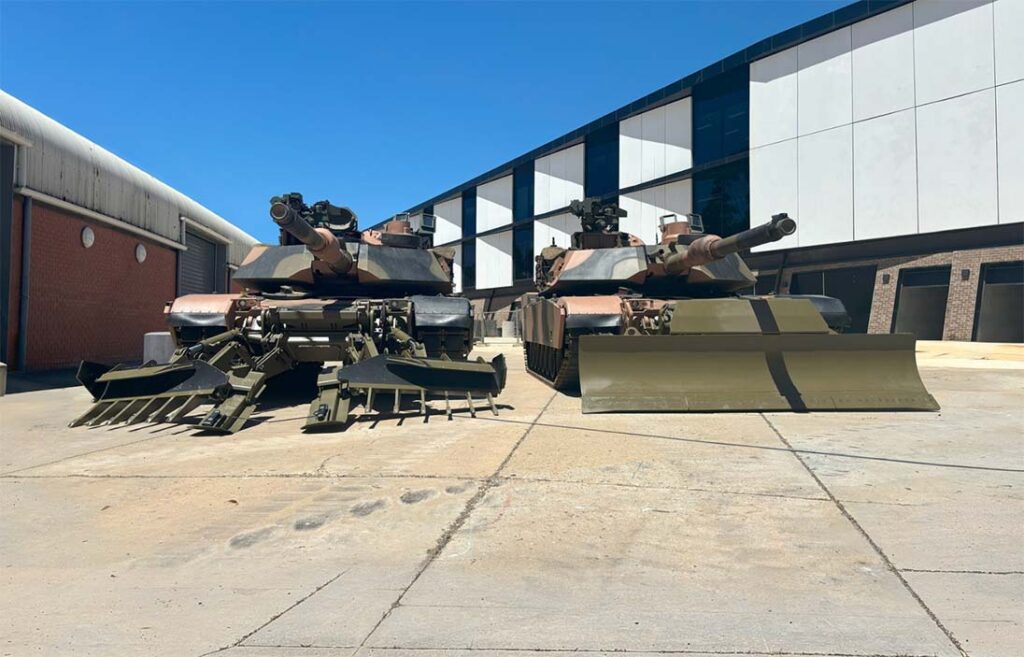
The ploughs have ground-engaging tines arranged across the full width of the vehicle, in order to displace buried, pressure-fuzed mines and create a safe route through the obstacle. This Wisent 1 mine-clearing configuration, which had already been proven at the time with various armed forces, including the Danes, is also equipped with a lane-marking system to aid the safe passage of troops following behind the vehicle. Part of Pearsons’ front-end equipment (FEE) range, the mine plough is designed to integrate with a variety of AFVs and MBTs to give any of them the capability to clear paths through minefields. The ploughs are deployed and used in the US with the MICLIC and M1150 systems, mentioned earlier.
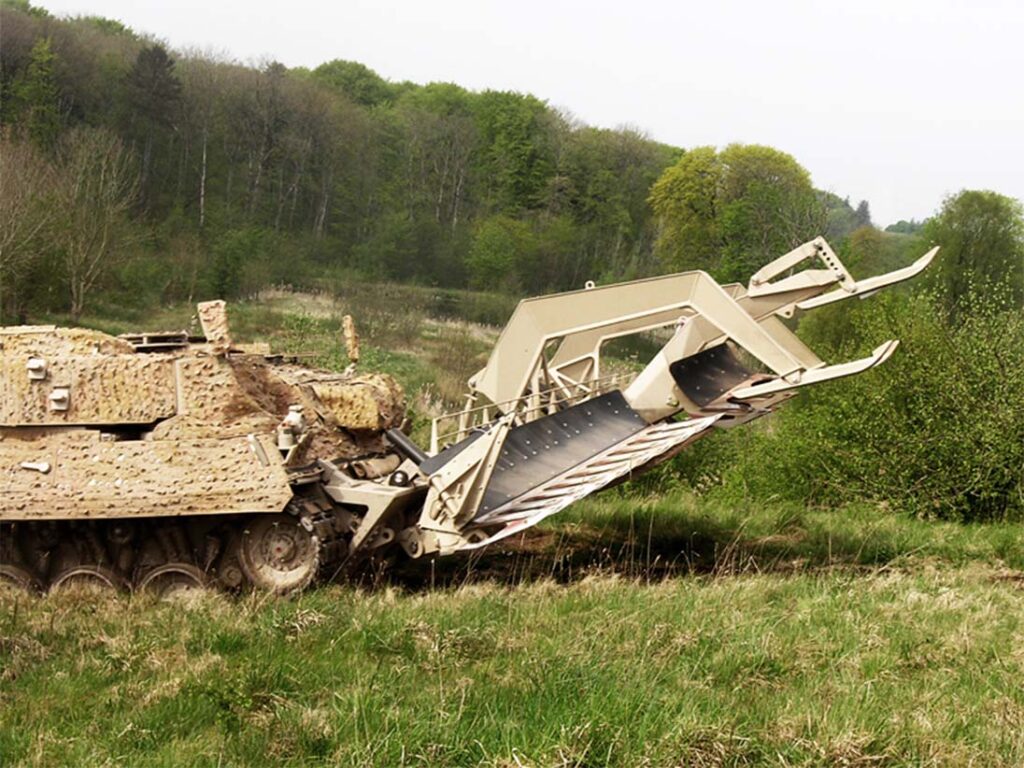
And while not in Ukraine, but in neighbouring Poland, March 2025 saw a contract award to Pearson, under which new M1A2 SEP V3 MBTs, destined for the Polish Armed Forces and part of a US Foreign Military Sales (FMS) deal, have been equipped with track-width mine ploughs, as well as combat dozer blades from Pearson. The integration has been conducted using the company’s SLICE vehicle interface kit, which enables the rapid conversion of a wide range of AFVs so they can carry Pearson FEE and conduct independent battlefield engineering operations themselves, if necessary, whether minefield, or other, obstacle clearing. SLICE was actually taken into service by an unnamed first customer during 2023 to enable interoperability of FEE with MBTs and dedicated engineering vehicles. Interestingly, this was around the time the company was dealing extensively with its support for the Ukrainian Armed Forces.
As a final thought, having explored minefield breaching as part of this discussion, with all the potential horrors it might bring to those attempting it, is that for any size of force – individual soldier up to mechanised battalion – doctrine is clear: the primary course of action is to avoid minefields whenever possible. Simply put: GO AROUND!
Tim Guest
Author: Tim Guest is a long-time freelance defence journalist, UK Correspondent for ESD, a former communications specialist in the defence industry and, previously, an officer in the British Army.