The IDF’s Carmel programme de facto shifted from development of a new armoured fighting vehicle to become a technology integration project around 2021. This piece examines some of the highlights to have emerged from the project thus far, and provides a glimpse of what to expect going forward.
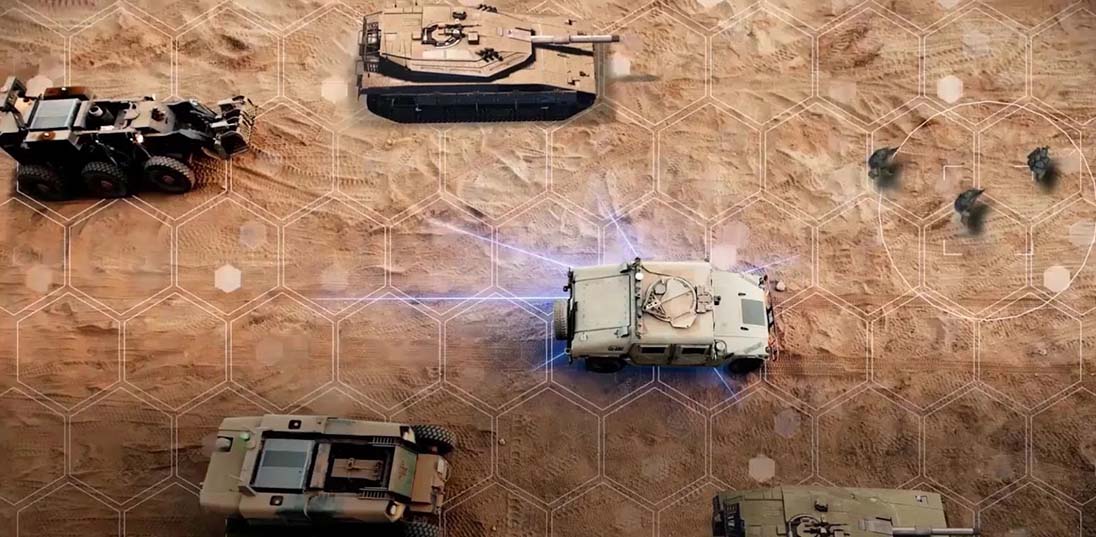
The Carmel programme was launched by the Israeli Defense Forces (IDF) in 2016 with the aim of developing a next-generation armoured fighting vehicle (AFV) concept that would be more agile and versatile than legacy systems. It would require a crew of only two (rather than the standard three or four) who would be seated in a digital cockpit. It would also rely heavily on autonomy, artificial intelligence (AI), augmented reality (AR) and sensor fusion, with the AI systems assuming the role of a ‘virtual third crew member’. The enhanced situational awareness provided by the new technology would permit the crew to operate the vehicle in ‘closed hatch’ mode even in urban settings, thereby enhancing safety.
Following the initial concept phase, the Ministry of Defense (MoD) decided to change the programme’s focus away from development of a single vehicle ‘next generation AFV’ concept; the new goal was the development of a multifaceted technology suite for integration into various AFV platforms. The firms Elbit, Rafael, and IAI submitted competing next-generation AFV demonstrator vehicles to the IDF. While all of these showcased immersive cockpits, AI-assisted crew capabilities, and autonomous navigation, each concept demonstrated different cockpit and autonomy solutions. In October 2021, Israel’s MoD selected Israel Aerospace Industries (IAI) as prime contractor for Carmel, eliminating the other two contenders.
Core technologies
The solution presented by IAI, as defined by the firm, is based on automatic and autonomous systems that complement the human crew and operate the combat vehicle’s central subsystems. By assuming numerous tasks, the AI component reduces the human crew’s stress during intense operations, allowing the soldiers to concentrate on the most vital decision-making functions. As described by IAI in the October 2021 press release announcing the contract award, “these capabilities allow the team to define, supervise and interfere only when there is a necessity or need, and enables (them) to cover a wider area of concern while effectively meeting the challenges faced by the manoeuvring forces. The system has the ability to locate and destroy time-sensitive targets with small footprints, through quick acquisition and effective engagement of targets.”

The envisioned solution is a ‘system of systems’. The technologies being developed under Carmel, as defined by IAI, fall into five categories:
- Command System – responsible for autonomous mission planning and management;
- Situational Awareness System – sensor fusion and AI enhancement of radar, signals intelligence (SIGINT) and optronic sensor data to ensure 360° ground and aerial threat detection. It is intended to be capable of classifying multiple contacts in real time and differentiating friend and foe;
- Lethality System – prioritises targets and threats, selects the optimal weapon and munition to combat each target, and rapidly engages targets;
- Mobility System – for autonomous route planning and navigation, to improve manoeuvrability in urban and complex terrain;
- Operations System – providing the crew with multidomain battlefield data and situational awareness as well as an innovative user interface to enhance decision making during combat operations. It forms the vehicle’s AI-enabled command-and-control framework. AI-based analysis and prioritisation of data flowing into the vehicle from the IDF’s overarching networked battle management system (BMS) reduces crew stress and provides clarity for making split-second decisions in combat. This acceleration of the OODA (observe–orient–decide–act) loop is particularly critical in clutter-rich urban environments.
Under the long-term programme focus, the goal is to enable a two-person crew to operate main battle tanks (MBT) and other AFVs, with AI handling navigation, target acquisition, and decision support. AI-enabled vehicles would then be able to form a multidimensional combat team exercising operational control of unmanned aerial vehicles (UAVs) and unmanned ground vehicles (UGVs).
Incremental implementation
The revised Carmel Programme is not developing a single comprehensive technology insert, but a series of complementary systems to be integrated on AFVs in order to significantly enhance future capabilities. Major components and subcomponents are being developed individually by various firms and integrated onto existing AFVs as they become available. The Merkava 4 Barak MBT, which entered service in 2023, was the first platform designated to operationally integrate some of the technologies trialled during the Carmel technical demonstration phase. Alongside the Merkava IV Barak, some of the trialled technologies or their offshoots have been making their way onto the Eitan 8×8 family and the Namer heavy tracked armoured personnel carrier (APC).
Barak MBT
The Barak MBT currently features the most complete set of Carmel technologies. When the tank was officially unveiled in September 2023, the then Israeli Defence Minister Yoav Gallant declared the tank to be an “extraordinary leap forward”. A joint statement by the MoD and IDF summarised the Carmel technology’s role in defining the upgraded combat vehicle’s capabilities: “Sensing and front-end processing capabilities based on artificial intelligence, the ability to reveal the enemy and create targets for combat troops on the battlefield, full combat in closed ranges based on 360° peripheral observation and a ‘pilot’s’ helmet for the commander, multi-touch screens, advanced operation controllers, adaptation to changing combat situations and improved survivability – these are just some of the capabilities of the new tank that was recently brought to service in the IDF.”
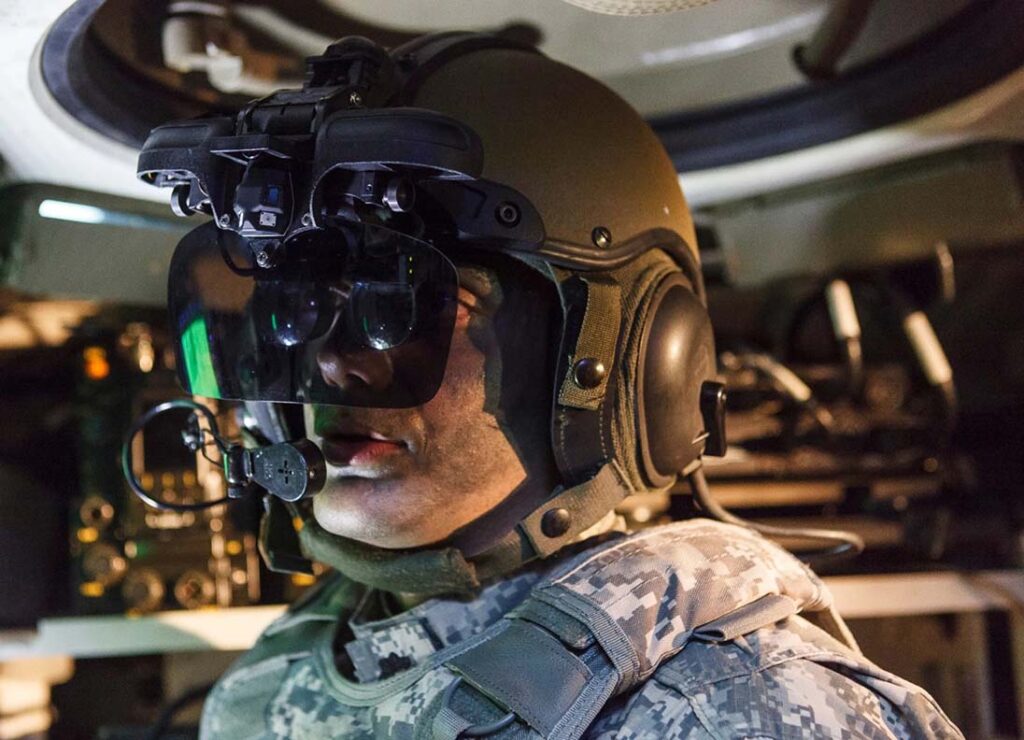
In detail, the suite on the Merkava Mk4 Barak includes:
- The full ‘combat cockpit’ configured with advanced crew stations featuring touchscreen displays, and sensor fusion.
- AI-driven situational awareness draws on multiple high-definition day/night external cameras and other sensors (including radars of the Trophy active protection system (APS), which is not itself Carmel-derived, along with signals intelligence sensors) distributed around the hull to jointly provide a 360° coverage of the vehicle’s surroundings. Imagery is fused and transmitted in full colour to the head-up display on the commander’s IronVision Augmented Reality (AR) helmet. As the tank commander turns his head, the camera facing in that direction slaves its feed to the helmet, enabling the commander to virtually ‘see through’ the hull to gain first-hand situational awareness while under armour. Only the vehicle commander is equipped with the AR helmet developed by Elbit Systems. However, situational data from the sensors is also displayed at the digital workstations of other crew members, primarily the driver and gunner; the data feed here is tailored to the requirements of each individual crew member.
- AI-assisted target recognition and prioritisation support is embedded on the Barak, identifying and classifying moving or static objects and persons using sophisticated algorithms and machine learning. While the AI rapidly devises a threat assessment and suggested order of engagement, the decision to engage and the act of firing primary and secondary weapons remains with the human crew. Still, the fire control system (FCS) integrates with the tank’s sensors and data processing capabilities, shortening the time needed to engage targets. The gunner’s workstation is equipped with a joystick used for aiming and firing the main gun, again facilitating rapid target engagement.
- The autonomous mobility systems trialled during the Carmel programme (such as automatic driving and navigation) are not yet in place.
In addition to the on-board systems, the tank is fully networked with the IDF’s combat cloud and command and control (C2) systems. Data is shared in real time – in both directions – with other AFVs as well as with command nodes, dismounted infantry and UAVs. This includes sharing the threat and target mapping generated automatically by the Carmel system using the onboard sensor data.
Eitan
The Eitan AFV will be produced in two variants. The Eitan IFV configuration (which will feature an unmanned turret mounting a 30 mm cannon) has been designated as the primary platform for evaluating Carmel technology integration on wheeled AFVs. However, the IFV variant is still in development and testing, with no official date provided for fielding.
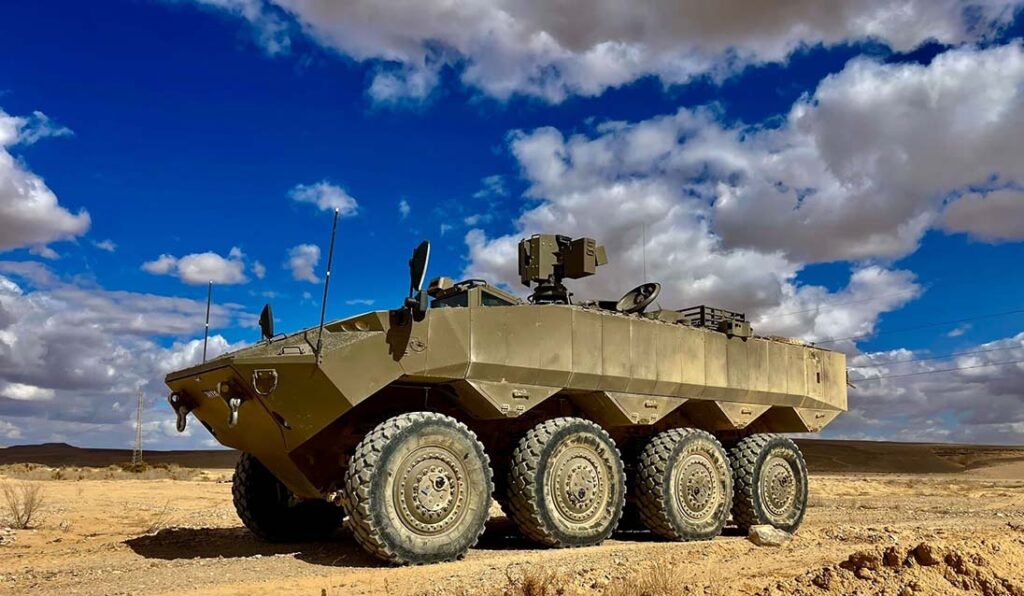
The operational APC version has been fitted with select components similar to those trialled on Carmel, such as the touchscreen-equipped digital combat cockpit; panoramic cameras distributed around the hull to provide 360° coverage of the vehicle’s surroundings; transmission of camera views to each workstation to provide real-time situational awareness; network integration and data sharing with the IDF MBSBMS).
However, the IronVision AR helmet has not been provided to the Eitan vehicle commander. Nor is the APC equipped with the full AI-guided sensor fusion suite or the advanced fire control and target prioritisation capability. As it currently stands, all indications are that the IDF will wait for the IFV variant of the Eitan before fielding such technologies on the platform. Nonetheless, the existing technologies which have been integrated optimise the APC for closed hatch urban fighting, enhancing both safety and lethality in such scenarios.
Namer
The Namer tracked heavy APC entered service in 2008 in limited numbers, with further vehicles trickling into service since. A limited number of vehicles are understood to have been equipped with Carmel-derived technologies, these thought to be the ‘Namer 1500’ variant, which purportedly also features a 1,119 kW (1,500 hp) engine.
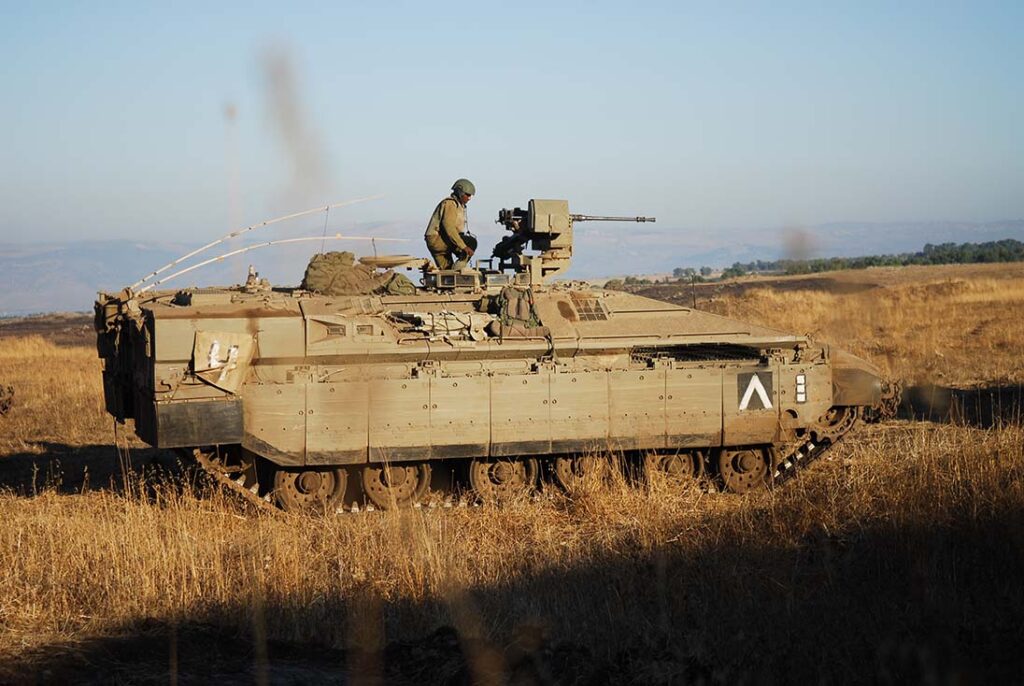
Namer 1500 deliveries commenced in 2023, and operational vehicles are understood have so far received limited Carmel-derived elements including digital crew displays (but not the full combat cockpit panoply) and the panoramic external camera suite to provide a 360° overview of the vehicle’s surroundings. Over time, fielding on the Namer is expected to continue to include deeper integration of multiple subsystems.
Doctrinal change
The Carmel programme is considered to be more than a standard technology upgrade. “The Carmel solution (…) includes a combination of capabilities, systems, groundbreaking innovation and connection to the world of AI as an additional strategic capability the IDF can use in the future battlefield. Carmel will enable complex ground operations with less risk to human lives, which will transform ground combat strategy as we know it today,” said IAI President Boaz Levy in 2021. Key shifts in operational doctrine being enabled or pushed by the new technology include:
- A survivability shift through closed hatch fighting: For decades, Israeli tank doctrine relied on the commander fighting ‘heads out’ for situational awareness, especially in urban environments. Carmel-derived technologies allow crews to remain fully closed hatch without losing awareness. Survivability is no longer traded against visibility. Closed hatch operations have become especially crucial since the introduction of small drones on the battlefield.
- Transformation of crew workload through AI assistance: Carmel-derived technologies are intended to reduce the cognitive burden under fire, allowing crews to focus on command decisions rather than sensor management.
- From platform centric to networked lethality: Network-enabled vehicles are intended to operate as nodes in a digital battlefield rather than as standalone vehicles, significantly enhancing survivability, lethality, and speed of combat operations, especially in dense urban terrain with asymmetric threats.

Going forward
Despite the successful integration work to date, the Carmel programme is far from complete. Several core elements are still under development or being refined, including the mobility suite for AI-driven autonomous route planning. The AI-driven lethality suite for target acquisition and prioritisation system, while already integrated onto the Merkava Mk4 Barak, also continues to be refined and advanced. As the subsystems mature and are proven on one operational platform, they will be incrementally integrated onto other in-service AFVs. In August 2025, the IDF announced a USD 1.5 billion initiative (subject to Knesset approval) to increase production of Merkava Mk4 Barak MBTs as well as Namer APCs and both Eitan APCs and IFVs over the coming five years. This production surge will be accompanied by expansion of the Carmel suite of capabilities on the respective AFVs.
While the IDF has not confirmed a ‘launch date’ for the Eitan IFV, the new procurement plan implies confidence that it will enter service by 2030. As the designated test bed for wheeled AFVs, it is likely to have considerably deeper Carmel integration than the current Eitan APC fleet. This would presumably include the full combat cockpit, advanced fire control, networked sensor fusion for 360° situational awareness, semi-autonomous driving capability, and teaming with/control of unmanned systems.
The Israeli MoD has stated that Carmel’s combat cockpit and AI systems will be gradually embedded across the IDF’s armoured fleet, which could mean eventual integration of the system onto armoured engineering and support vehicles. Future AFVs are likely to integrate the full ‘Carmel suite’ from the beginning. For that matter, it stands to reason that the Carmel programme itself is unlikely to reach an actual end-state. Individual elements will continue to be refined, and totally new technologies may well flow into the suite over time. Deeper levels of AI support and autonomy would be consistent with technological trends in leading armed forces around the world. Introduction of an optionally unmanned capability cannot be ruled out. As the Carmel programme evolves and proves itself operationally, the conceptual ‘common suite’ model could become a relatively attractive option for other armed forces to consider adopting.
Sidney E. Dean