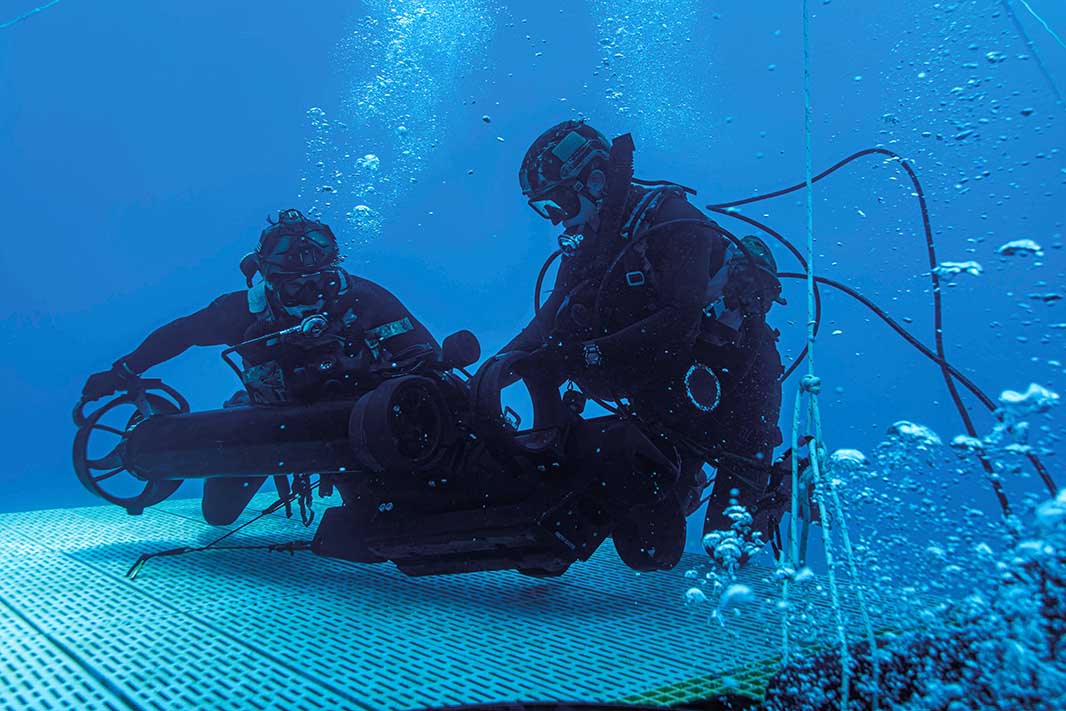
Recent incidents as far apart as the Baltic and the waters off Taiwan have highlighted the vulnerability of critical underwater infrastructure to malign actors. Whilst such threats have a long history, the increased significance of subsea assets to global economic activity underlines the importance of understanding these dangers and devising appropriate responses. On the positive side, there is now a strengthened awareness of the importance of this infrastructure and the nature of the risks it faces. However, developing appropriate solutions for these hazards remains a work in progress.
Whilst largely hidden from public gaze, a range of undersea assets increasingly form a crucial part of daily economic activity. This critical underwater infrastructure (CUI) spans a spectrum of assets laid across the seabed that are frequently divided into three main categories:
- Subsea communications cables:Successors to the telecommunications copper cables of yesteryear, today’s network of submarine fibre-optic cables handles vast quantities of data, forming a vital global, regional and national communications network.
- Underwater electricity cables: Typically comprising insulated copper cables, these facilitate the interconnectivity of national and regional electricity grids and form crucial links with the offshore wind farms that have become a major part of the transition to green energy.
- Oil and gas pipelines: These networks of hollow pipes connect production fields to end markets, often over vast distances.
Underwater CUI is installed, owned and operated by a diverse array of public and private entities. This can give rise to a degree of duplication and redundancy, particularly in the communications sphere, but also a lack of standardisation. The nature and location of the infrastructure involved often enhances its exposure to attack and disruption. In particular, it frequently lacks significant physical protection, whilst its extent and remoteness can make effective surveillance difficult. Conversely, concentration of infrastructure around key nodes, for example where cables and pipelines make landfall, provides opportunities for hostile actors to create disproportionate disruption. The financial costs of damage can be huge. For example, it has been estimated that the direct costs associated with the September 2022 Nord Stream pipeline explosions were considerably in excess of EUR 1 billion.
A history of risk
Attacks on underwater infrastructure are by no means new. The outbreak of the First World War saw both Imperial Germany and the British Empire initiate measures to disrupt and disable their opponents’ undersea telegraphic cables, although it was Britain’s command of the seas that proved decisive. The effective destruction of much of the German network hindered its ability to communicate beyond the European continent and left these communications inherently vulnerable to interception. This was an important element in the British decryption of the infamous Zimmermann telegram that hastened the United States’ entry into the war. Later, interception of Soviet submarine cables by NATO during the Cold War yielded valuable intelligence information.

Although hostile attacks on CUI therefore have a long history, it is important to note that such disruption is by no means the most significant threat. A recent RAND Corporation study has estimated that around 40% of known disruption to this infrastructure is related to fishing and a further 15% to natural hazards such as storms. Despite this, a series of recent incidents have highlighted the potential for more malevolent intervention. These include the cutting of two subsea cables linking Taiwan’s Matsu Islands to Formosa in February 2023 in events that were linked to the nearby presence of Chinese vessels. In Europe, the Baltic region has seen a series of disruptions since the outbreak of the Russo-Ukrainian war. Notably, a spate of incidents towards the end of 2024 saw the severance of the BCS East-West Interlink and C-Lion1 subsea communications cables, as well as the Estlink 2 underwater power cable. Whilst it has been speculated that these events were the result of hybrid warfare sponsored by Russian intelligence agencies, no definitive evidence of hostile intent has entered the public domain.
All these incidents are illustrative of the particular vulnerability of CUI to the increasingly prevalent trend towards ‘grey zone’ or hybrid warfare. In this sphere, the cutting of a cable by the ‘accidental’ dragging of a merchant vessel’s anchor or a breach in a pipeline due to an unknown cause can be cloaked under the veil of plausible deniability. The resulting damage and disruption can be disproportionate to the effort involved and the direct consequences limited. It is also arguable that international maritime law has failed to keep pace with this evolving environment, with the scope for taking preventative action outside of a country’s territorial waters seemingly uncertain. In November 2025, the Helsinki District Court ruled that criminal charges against some of the crew of the vessel involved in the Estlink 2 incident could not be pursued as the case fell outside of its jurisdiction under United Nations Convention on the Law of the Sea (UNCLOS) principles.
Although such low level, grey zone attacks by state-sponsored actors have the potential to cause considerable harm, they are by no means representative of the full extent of the threat CUI currently faces. For example, rapid developments in the availability and cost of relevant technology such as uncrewed underwater vehicles (UUVs) holds out the prospect that terrorists or criminals could also target CUI for their own purposes. At the other end of the scale, it is conceivable that CUI could be the subject of a more widescale assault as part of the precursor to a more conventional military conflict. The activities of the Russian Navy’s Project 22010 oceanographic research vessel RFS Yantar in mapping subsea communications cables in both European waters and beyond, doubtless providing the information needed for such an attack, have been widely reported. In December 2025, British First Sea Lord General Sir Gwyn Jenkins highlighted broader Russian investment in its Main Directorate of Deep-Sea Research (GUGI) – including deep sea submersibles – in an interview with the Financial Times in the context of a growing risk to the United Kingdom’s critical seabed cables and pipelines. As is the case for deniable hybrid actions, the legal scope to challenge these surveillance activities when they are conducted outside of territorial waters is limited.

A collaborative response
The vulnerability of CUI to hostile action has, of course, not gone unnoticed. This has resulted in the rapid expansion in national and cross-border activity to deter and respond to the threat, particularly by European nations facing what are arguably the most intensive risks. Whilst European Union activity has largely been at the policy level, NATO created a strategic Critical Underwater Infrastructure Coordination Cell at its Brussels headquarters in February 2023 and followed this by standing up a more operationally-focused Maritime Centre for Security of Critical Undersea Infrastructure in May 2024. The latter is based at NATO Allied Maritime Command (MARCOM) in Northwood near London. It is described by the Alliance as a “…networking and knowledge centre concentrating on CUI” to assist “Commander MARCOM in making decisions, deploying forces and coordinating action”.
Another important part of the jigsaw of partnerships strengthening the protection of CUI is the UK-led Joint Expeditionary Force (JEF), which is also headquartered at Northwood. Comprising ten NATO members in the Nordic, Baltic and North Sea regions, this essentially provides a pool of high-readiness assets to deter malevolent actors and permit a rapid response to any incidents, complementing NATO’s activities. The JEF has been taking an increasing interest in safeguarding CUI, undertaking exercises in 2023 and 2024 aimed at improving its capacity to counter the more threatening environment. The 2024 activities, known as JEF Response Option activity NORDIC WARDEN, involved a month-long series of activities by ships and aircraft drawn from JEF participants encompassing CUI from the North Atlantic through to the Baltic.
Beyond Europe, the protection of CUI appears to remain more of a national endeavour despite the regionally interconnected nature of many of the assets involved. There is, however, a growing understanding that the vulnerabilities demonstrated, particularly, by events in Europe have broader relevance. For example, the Association of Southeast Asian Nations’ ASEAN Digital Masterplan 2025 takes embryonic steps to improve the resilience of the region’s submarine cables and provide transnational access for cable repair. The Quadrilateral Security Dialogue (Quad) between Australia, India, Japan and the United States also announced its own programme for CUI protection, the Quad Partnership for Cable Connectivity and Resilience, at its May 2023 summit. Whether this initiative will endure the increasingly transactional focus of the second Trump presidency must remain a matter of conjecture.
Developing practical capabilities
It is clear from the above analysis that, at least in Europe, a strategy for the requisite collaborative approach to combatting the threat to CUI is already well underway. For this response to be effective, however, this strategic dimension needs to be accompanied by the acquisition of appropriate materiel to identify and respond to the danger.
A fundamental capability requirement is improving the surveillance of infrastructure which, as previously noted, is extensive in nature and frequently located in remote and hostile environments. A range of solutions have been implemented, or are under development, to alleviate these challenges. These include the use of satellite imagery to track the activity of potential hostile surface vessels, the use of autonomous USVs to undertake remote surveillance of the seabed and the use of fixed-point sensors to detect anomalies. The pace of technological development is rapid. For example, in November 2024, Thales announced an agreement with another French company, FEBUS Optics, to utilise the latter’s distributed fibre optic sensing (DFOS) technologies to enhance the functionality of its existing BlueGuard sonar system. DFOS can be used to monitor the water space around the entire length of a piece of CUI, detecting acoustic signals generated close to the infrastructure being monitored.
Another important example of technological development is the down-scaling of sonar technologies to integrate with the new generation of uncrewed platforms. In December 2025, SEA, part of the British Cohort group, revealed it had been awarded a multi-million-pound contract to supply 22 of its KraitArray undersea sensing systems to Liquid Robotics, a Boeing Company, for integration into the company’s Wave Glider uncrewed surface vessel (USV). Described by the company as delivering high-end, passive acoustic detection performance in a compact, modular form, KraitArray – and similar compact sonars – offer the prospect of significantly improving the ability of uncrewed platforms to provide enhanced intelligence and maritime domain awareness in support of CUI protection.
The development of improved monitoring capabilities is being accompanied by the acquisition of specialised surveillance ships to deploy and support the array of new equipment. An early example is the British Royal Fleet Auxiliary service’s multi-role ocean surveillance ship RFA Proteus, a former commercial offshore support vessel brought into naval service in 2023. Whilst the detailed concept of operations underpinning her purchase is shrouded in secrecy, her ability to deploy a range of underwater vehicles provides the United Kingdom with significant deep-sea deterrence and response capabilities. A number of other European countries have announced plans to operate similar vessels, most recently the Danish Ministry of Defence’s purchase of the commissioning service operation vessel Norwind Helm at the end of 2025. All-in-all, the arrival of these vessels significantly enhances the potential of European navies to respond to the threat posed to CUI.

An integrated response
Despite this progress, much still remains to be done, particularly in developing appropriate operational concepts. Given the vast, distributed nature of the infrastructure involved, it would seem that an integrated approach is necessary, combining the capacity of traditional assets such as crewed ships, submarines and aircraft with newer technologies, such as uncrewed vehicles and artificial intelligence (AI). A good example of the likely direction of travel is the British Royal Navy’s Project CABOT, which aims to provide a persistent anti-submarine warfare (ASW) surveillance capability in the North Atlantic. Whilst focused on the broader spectrum of threats posed by Russian submarine and other sub-sea activity, the defence of CUI forms an important part of its scope.
It is intended to be delivered in two phases:
- Atlantic Net: Envisaged to be an interim capability delivered by industry, this will use uncrewed vehicles operated by commercial partners to provide AI-assessed acoustic data for further Royal Navy analysis. It will be a relatively lowcost phase that will enhance undersea surveillance whilst allowing crewed assets to be focused on other missions.
- Atlantic Bastion: A more comprehensive solution using an armed forces-operated model will encompass an integrated network of crewed and uncrewed surface vessels, submersibles and aircraft to provide an enhanced capability. These assets will include traditional platforms such as the Type 26 ASW frigates and P-8A Poseidon maritime patrol aircraft, as well as uncrewed vehicles such as a proposed Type 92 ASW USV sloop and Type 93 ‘Chariot’ UUV.
Although developed as a national, British capability, it seems likely that the project will be expanded to encompass other regional allies. For example, growing strategic cooperation with Norway – illustrated by its acquisition of Type 26 frigates and the December 2025 signature of the Lunna House Agreement – looks set to see it emerge as a crucial player in the Atlantic Bastion concept.
Currently at the start of its implementation, Project CABOT is very much a work in progress that is likely to yield important lessons for the protection of CUI in other parts of Europe and beyond. It is, however, important not to view it as a universal panacea to the threat posed to CUI worldwide. The attractiveness of seabed infrastructure to hostile actors suggests it will prove impossible to deter or prevent all future attacks. This makes both resilience and the ability to conduct rapid repairs other important parts of the defensive armoury.
Indeed, some commentators have suggested that the ready availability of specialised repair shipping might be a significant constraint in responding to any concerted attack on CUI. In September 2025, the UK Parliament’s Joint Committee on National Security Strategy recommended the acquisition of a genuinely sovereign British cable repair ship by 2030 in a report on the resilience of subsea telecommunications tables. More broadly, it will be important to ensure effective information sharing and cooperation with often private sector owners of critical assets, as well as to take care that their builders and operators remain aligned with national interests. Notably, the United States has been proactive in taking steps to prevent China’s HMN Technologies from gaining a dominant position in subsea cable laying, largely over espionage fears.

Conclusion
It is evident from this short overview that the world is entering a new phase in the long history of threats to CUI. Moreover, these threats are both increasing and multi-faceted. Encouragingly, the nature of the danger and the importance of combatting it appear to be well-recognised. Particularly in Europe, co-ordinated international action is being taken to mitigate and combat the danger. This is being accompanied by the development of improved technologies and new operational concepts that hold out the prospect of significant progress in the areas of surveillance and threat detection. However, the challenge is immense, relying on an integrated response that extends beyond operational command and control as far as the commercial and legal domains. Much work remains to be done.
Conrad Waters
Author: Conrad Waters is a naval and defence analyst. He iseditor of Seaforth World Naval Review, Joint Editor of Maritime Defence Monitor and a regular contributor to other Mittler Report publications.
Click here to read the latest issue of ESD.

