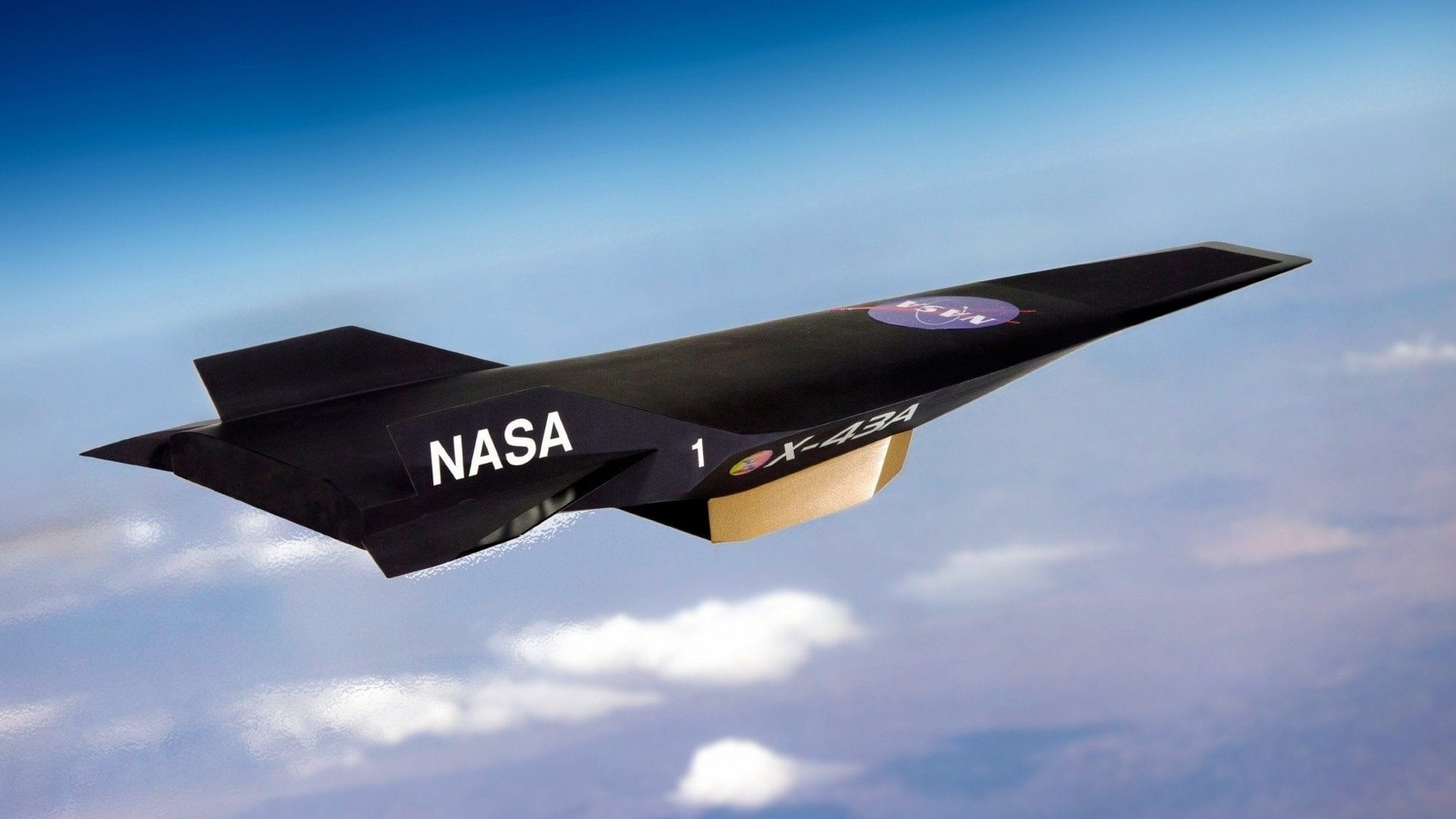
Summary and Key Points: On November 16, 2004, a twelve-foot unmanned NASA aircraft lit a scramjet with no moving parts and rode it to Mach 9.6 — nearly ten times the speed of sound — a record still unbroken twenty years later.
-NASA had already mapped its Mach 15 successor, the X-43D.
The X-43A was a small experimental research aircraft designed to flight-demonstrate the technology of airframe-integrated supersonic ramjet or “scramjet” propulsion at hypersonic speeds above Mach 5, or five times the speed of sound. Its scramjet engine is an air-breathing engine in which the airflow through the engine remains supersonic.
-It was never built, and the US spent the next two decades watching Russia and China field the hypersonic weapons it chose not to chase.
The Mach 15 Machine That Never Flew: How NASA’s X-43A Smashed Every Speed Record And Then Walked Away From The X-43D
On November 16, 2004, a twelve-foot black wedge of an aircraft dropped from beneath the wing of a B-52 over the Pacific Ocean, rode a Pegasus booster rocket up to 109,000 feet, separated, and lit an engine with no moving parts.
For roughly ten seconds, the little unmanned vehicle accelerated under its own power to nearly ten times the speed of sound, and in doing so it set a record that has never been broken. The X-43A reached Mach 9.6, almost 7,000 miles per hour, and proved that an air-breathing engine could sustain combustion at hypersonic speed in real flight rather than in a wind tunnel or a computer model.
The engine that made it possible was a scramjet, short for supersonic combustion ramjet, and the challenge it solved was as difficult as anything in aviation. A scramjet has no rotating compressor, no fan blades, no moving parts at all. It relies entirely on the aircraft’s own velocity to ram air into the engine and compress it, then injects hydrogen fuel and burns it while the air is still moving through the engine at supersonic speeds.
Igniting fuel in a supersonic airstream has been compared to striking a match in a hurricane and keeping it lit, a feat that requires precise control of temperature and pressure inside an engine where the air is tearing through in milliseconds. Before the X-43A, no one had ever sustained that kind of combustion in free flight.
The payoff for solving that problem was enormous, and it was the reason NASA pursued the technology in the first place. Because a scramjet scoops its oxygen from the atmosphere rather than carrying heavy tanks of oxidizer the way a rocket does, the aircraft is lighter and can carry heavier payloads, opening the door to vehicles that could make quick jumps across oceans or climb toward orbit far more efficiently than a rocket ever could. The dream behind the program was a future in which scramjet-powered aircraft might one day turn an eighteen-hour flight from New York to Tokyo into a two-hour hop. That dream was the prize. The X-43A was the first proof it might be reachable.
X-43A: The Program Built On Decades Of Risk
The X-43A did not appear out of nowhere. It was the product of NASA’s Hyper-X program, an eight-year, roughly $230 million effort conceived in the 1990s as one of the agency’s “better, faster, cheaper” initiatives, and it represented the first dedicated hypersonic research aircraft program since the X-15 rocket plane of the 1960s. The connection to that earlier machine ran deeper than reputation.
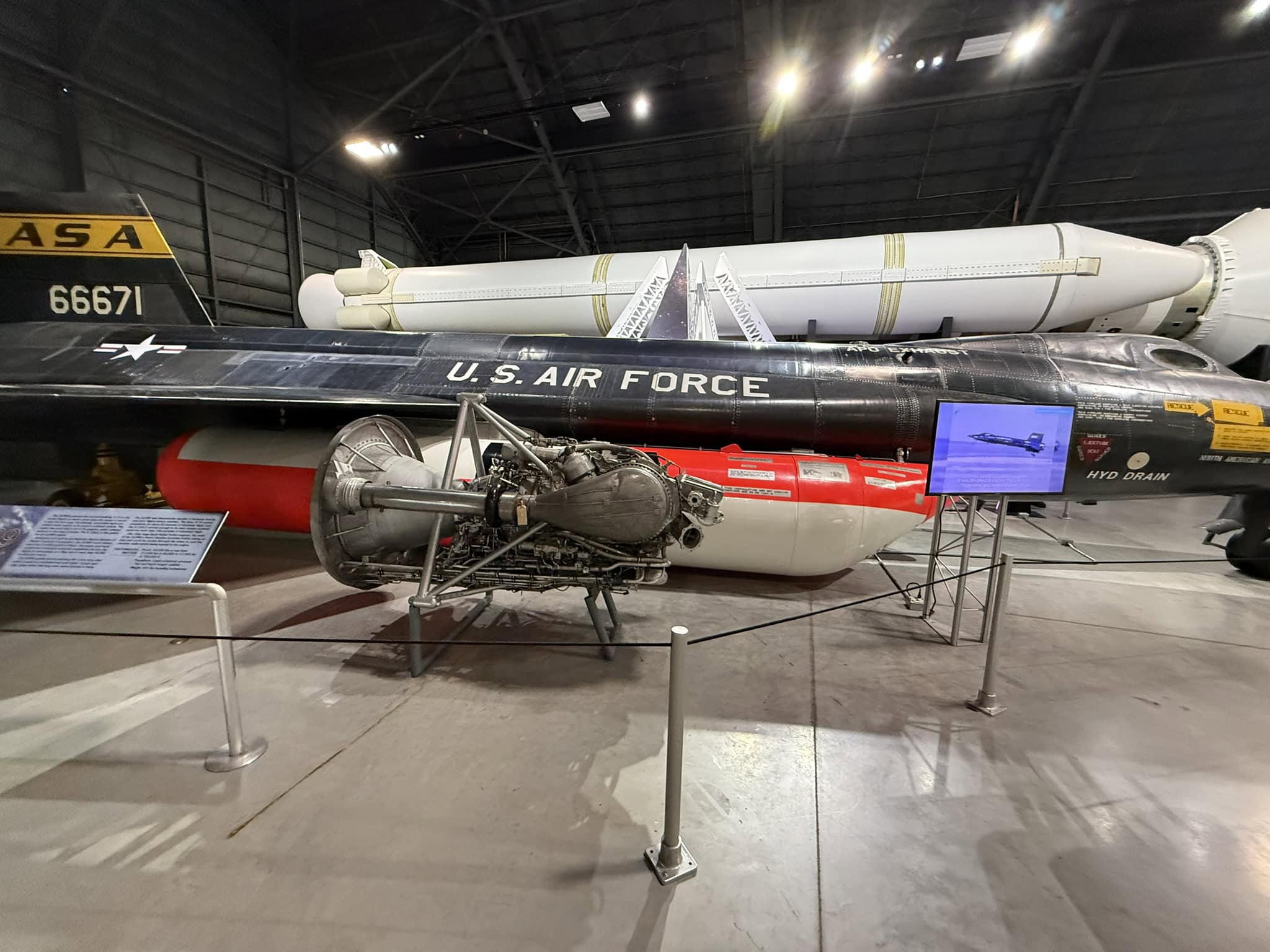
This is an image of the X-15 taken by Editor-In-Chief of 19FortyFive.com Harry J. Kazianis back in 2025 and the National Museum of the U.S. Air Force.
One of the final goals of the X-15 program had been to test a scramjet design, and in 1967 engineers at Dryden had fitted a mock version of such an engine beneath the X-15 to study its aerodynamics at Mach 7. The X-43A was the realization, nearly four decades later, of an idea the X-15 had only been able to gesture toward.
NASA built three of the small aircraft, splitting the work between two of its centers. Langley Research Center in Virginia led the hypersonic technology development, while Dryden Flight Research Center at Edwards Air Force Base in California handled hardware integration and the actual flight testing, with every flight staged out over the Naval Air Warfare Center’s sea range off the southern California coast. The first two vehicles were built to fly at Mach 7, and only the third was configured for the full Mach 10 attempt. Each one was designed to fly exactly once before tumbling into the Pacific, a deliberately disposable testbed meant to wring maximum data out of a single brief powered run.
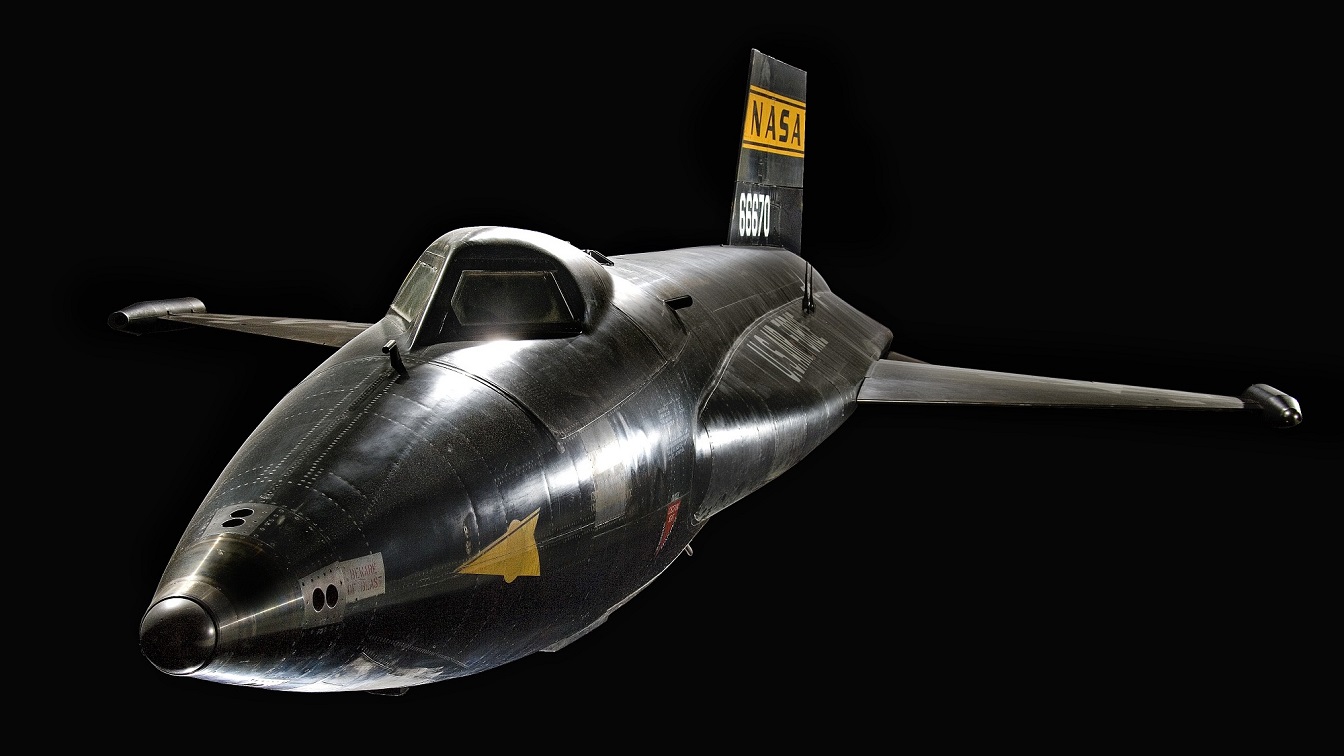
Three-quarter left front view of the North American X-15 (s/n 56-6670) at the Smithsonian National Air and Space Museum, July 10, 2007
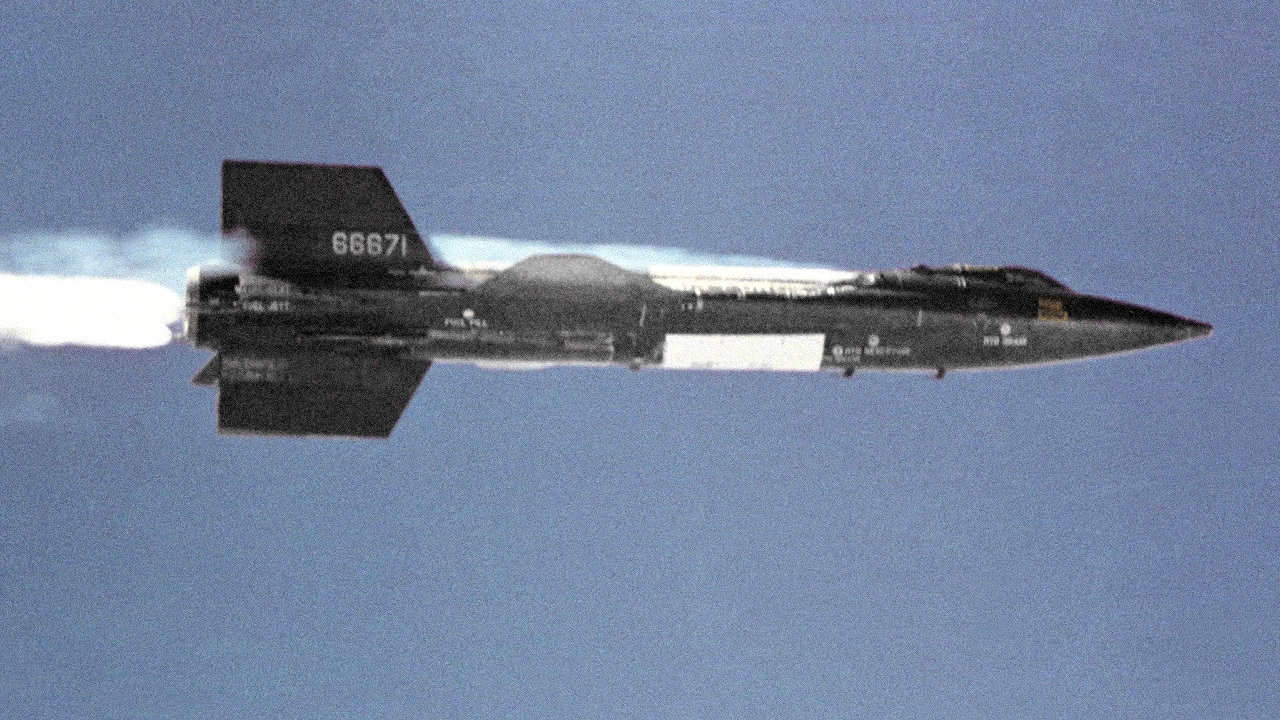
X-15. Image Credit: NASA.
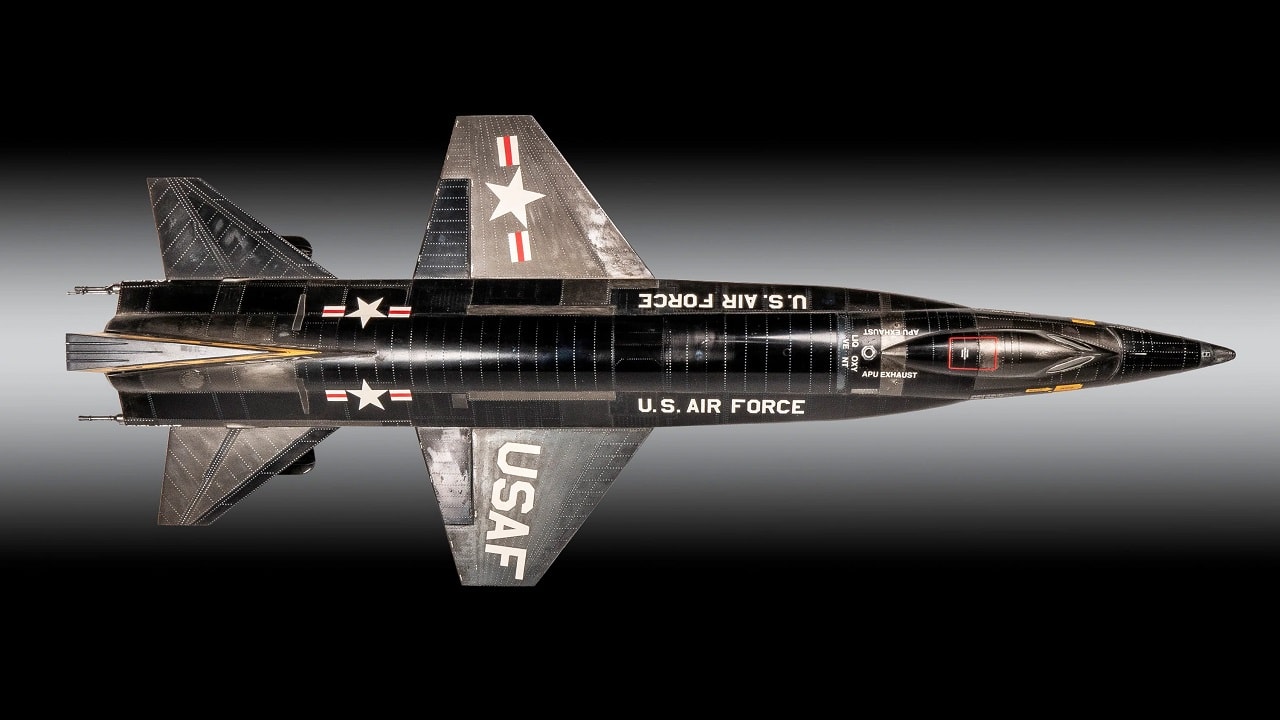
X-15. Image Credit: Creative Commons.
The engineering challenges were severe across every discipline at once. At speeds approaching Mach 10, air friction generates temperatures exceeding 2,000 degrees Fahrenheit on the airframe, hot enough to destroy conventional aircraft structures. To survive that environment, the X-43A was built using advanced carbon-carbon composites and specialized alloys capable of holding their structural integrity under extreme thermal stress. The scramjet itself was integrated directly into the lower fuselage of the aircraft, with the vehicle’s own shape doing the work of compressing the incoming air, so that the airframe and the engine were effectively a single aerodynamic system rather than a plane with a motor bolted on.
The Flights That Made History
The road to the record ran through an early, public failure. The first X-43A flight, in June 2001, ended in disaster when the Pegasus booster carrying the vehicle lost control shortly after release from the B-52, and the vehicle had to be destroyed before it could even ignite its scramjet.

A B-52 Stratofortress from Barksdale AFB is parked on the flight line at Fairchild Air Force Base, Washington, Aug. 16, 2022. The B-52s landed at Fairchild to conduct their own Agile Combat Employment exercise creating more multi-capable Airmen ready to deploy anywhere, anytime. (U.S. Air Force photo by Staff Sgt. Lawrence Sena)
The setback raised exactly the questions that kill experimental programs: how much more money, how much more time, and whether the concept was worth chasing at all. NASA pressed on.
The decision was vindicated on March 27, 2004, when the second X-43A flew successfully and became the first air-breathing scramjet-powered aircraft to fly freely under its own power. The booster carried it to roughly 95,000 feet, the vehicle separated, and the scramjet ignited and operated for about ten seconds on its hydrogen fuel supply, driving the aircraft to Mach 6.83, around 5,000 miles per hour. NASA’s Hyper-X propulsion lead called it a great, record-breaking day, and it was, because the vehicle achieved positive acceleration while climbing and held outstanding control throughout, demolishing the previous speed record for air-breathing flight. The aerospace contractor Boeing, which contributed key research expertise to the vehicle, noted that the scramjet’s design with significantly fewer moving parts than a traditional turbojet and no need for onboard oxidizer was central to what made the achievement possible.
Then came November 16, 2004, and the flight that still stands at the top of the record books more than two decades later. The third and final X-43A was boosted to about 109,000 feet and accelerated to Mach 9.6, a result that earned the aircraft a Guinness World Record.
The certificate from Guinness recorded the achievement precisely, noting that on that date NASA’s unmanned Hyper-X aircraft reached Mach 9.6 after being boosted to 33,223 meters by a Pegasus rocket launched from beneath the B-52. To put the achievement in context, NASA noted that the previous record for an air-breathing vehicle, held by a ramjet-powered missile, was barely above Mach 5, and that even the legendary rocket-powered X-15 had topped out at Mach 6.7. The X-43A had not just broken the record. It had obliterated it, and it had done so with an engine that breathed air rather than carrying its own oxygen.
The Logical Next Step On The Drawing Board: Mach 15?
The X-43A was never meant to be the end of the story. It was the first rung of a ladder, and NASA’s planners had already mapped out the rungs above it. The Hyper-X roadmap envisioned a family of vehicles, each pushing the technology into new territory. The X-43B was conceived as a demonstrator for a combined-cycle engine that would function as an ordinary turbojet at low speeds and switch to scramjet mode at high altitude and velocity, the kind of engine a real reusable aircraft would need to take off, accelerate, and cruise. The X-43C was designed to demonstrate a scramjet burning practical hydrocarbon fuel rather than hydrogen, at speeds between Mach 5 and 7, pushing the technology closer to something a fieldable weapon or aircraft might actually use.
At the top of the ladder sat the most ambitious concept of all. The X-43D was designed to be a direct descendant of the X-43A, another small unpiloted testbed with a hydrogen-fueled scramjet, but built to push from the merely hypersonic regime into true hypervelocity flight at roughly Mach 15. A NASA hypersonics overview from Langley’s Vehicle Analysis Branch laid out the X-43B, X-43C, and X-43D as the planned progression, and the higher-speed D variant was intended to gather flight data on how scramjets behave as heating, airflow compression, and structural loads increase dramatically above Mach 10. The proposed variants together were meant to map out the full operational envelope of scramjet propulsion, with the D models assessing the brutal conditions at the extreme edge of what an air-breathing engine could survive. A Mach 15 flight would have answered questions about materials, guidance stability, and engine operability that no ground facility on earth could fully simulate.
Why The Mach 15 Machine Died On Paper
The X-43D never left the drawing board, and the reason had almost nothing to do with whether it would have worked. It was a casualty of timing, budgets, and a sudden change in what NASA was being asked to do. In January 2004, President George W. Bush announced the Vision for Space Exploration, a sweeping directive that refocused the agency on returning humans to the Moon and eventually reaching Mars. That announcement redirected NASA’s money and attention toward human spaceflight and, in particular, toward the Space Shuttle’s return to flight after the Columbia disaster and the later Constellation program.
In that environment, high-risk experimental aircraft became very hard to justify. The X-43B and X-43C were cancelled in March 2004 because of the shift in NASA’s strategic goals following the Vision for Space Exploration announcement, even though Congress was impressed enough by the X-43A’s success to add $25 million to the 2005 budget in an attempt to keep X-43C development alive.
The reprieve did not hold. As funding and organizational priorities shifted toward space exploration, the entire follow-on family withered, and the X-43D never passed its initial design phase. NASA’s own framing was that the X-43 program had not so much been killed as concluded, having been a narrowly defined three-flight effort to demonstrate scramjet technology, and once the third flight succeeded in 2004, the agency had the data the program was chartered to collect.
That framing is technically accurate and strategically incomplete. The narrow objectives were met, but the roadmap that the X-43A was supposed to begin was abandoned with them. The Mach 15 vehicle that NASA’s own planning documents had laid out as the next major step into hypervelocity flight simply ceased to be a priority, and the specific hole it was meant to fill, hydrogen scramjet flight at roughly Mach 15, was left open.
The torch did not go out entirely. The Air Force picked up the scramjet effort with the X-51A Waverider, a hydrocarbon-fueled vehicle that first flew in 2010 and eventually achieved several minutes of powered flight around Mach 5, a longer burn than the X-43A’s brief ten-second runs but at far lower speed. The X-51 advanced the practical, fieldable side of the technology. It did not chase the extreme-velocity frontier the X-43D was designed to explore.
What The Gap Cost
Two decades later, the consequences of that abandoned roadmap have become a subject of real strategic concern. The world in which the X-43D was never built to fly has been replaced by one in which hypersonic weapons are an operational reality rather than a research curiosity.
Russia fields the Avangard boost-glide vehicle on intercontinental missiles, a system capable of maneuvering unpredictably at speeds above Mach 20, and China has paraded the DF-17, a medium-range missile paired with a hypersonic glide vehicle designed for the Western Pacific.
The problems the X-43D was meant to solve, high-temperature materials, guidance stability at extreme speed, engine operability, and the aerodynamics of flight beyond Mach 10, map almost directly onto the challenges that militaries are now scrambling to master.
There is a genuine irony in that. The United States flew an air-breathing hypersonic vehicle at Mach 9.6 in 2004, longer ago than many of the engineers now working on hypersonics have been in the field, and then declined to take the next step its own roadmap had described. The X-43A proved the country could do something no one else had done, and the decision to stop meant that the higher-Mach testbed that would have built directly on that achievement was never flown, even as the strategic value of exactly that knowledge climbed year after year.
The X-43A Deserves a Page in History
The X-43A remains the fastest air-breathing aircraft ever flown, a record untouched for more than twenty years, and a monument to what a small team with a disposable twelve-foot vehicle and a willingness to fail could accomplish. The X-43D remains a set of viewgraphs and feasibility studies, a Mach 15 machine that existed only on paper, and one of the more tantalizing what-ifs in the history of American aerospace.
The little black wedge that lit a match in a hurricane and rode it to nearly ten times the speed of sound did everything it was asked to do. The country simply chose not to ask for more.
About the Author: Harry J. Kazianis
Harry J. Kazianis (@Grecianformula) was the former Senior Director of National Security Affairs at the Center for the National Interest (CFTNI), a foreign policy think tank founded by Richard Nixon based in Washington, DC. Harry has over a decade of experience in think tanks and national security publishing. His ideas have been published in the NY Times, The Washington Post, The Wall Street Journal, CNN, and many other outlets worldwide. He has held positions at CSIS, the Heritage Foundation, the University of Nottingham, and several other institutions related to national security research and studies. He is the former Executive Editor of the National Interest and the Diplomat. He holds a Master’s degree focusing on international affairs from Harvard University. Kazianis is Editor-In-Chief of 19FortyFive.