As threats become more prolific, littoral naval operations grow increasingly challenging. Success is dependent on an individual ship’s Combat Information Centre (CIC) and how that team performs. That performance is characterised by type, relevance and intensity of training that crews receive before deployment.
Perhaps the best exemplar of the current threats faced by naval operations can be found in the Red Sea. As naval operations have inexorably shifted from the blue water battleship-versus-battleship engagements conducted over range and typified during the Second World War, today’s naval conflicts have become more littoral, which has raised the threat stakes. These threats are now delivered from the sea, air and increasingly, from land. The latter domain includes anti-ship cruise missiles (ASCMs), such as the Iranian Noor family with ranges varying from 30 km to 220 km. Longer range and more powerful ballistic missile options include the Chinese DF-21D and DF-26B, the so-called “carrier killers” with maximum ranges of 2,150 km and 4,000 km respectively.
As well as the threat posed by anti-ship ballistic missiles (ASBMs), lower-cost unmanned aerial vehicles (UAVs), such as the Iranian Shahed-136 drone, can carry a 50 kg warhead out to a maximum range of 2,500 km. Typically used by the Houthi rebels against Western navies or merchant vessels in the Red Sea, this low-cost weapon platform is typically used in swarm attacks where a number are flown at a warship from different directions and varying heights in an attempt to swamp sensors and defensive weapons.
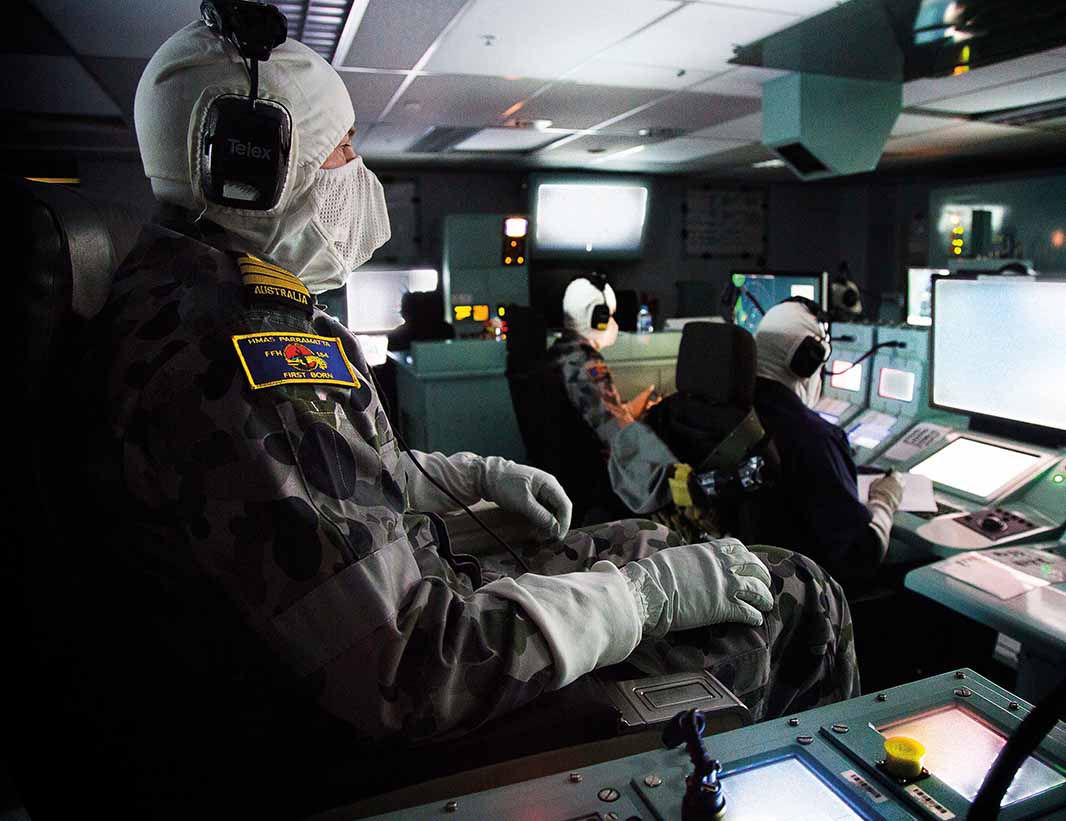
These new challenges – alongside air and groundlaunched hypersonic and supersonic missiles, mines, high-speed drone and manned suicide boats, surface and sub-surface launched torpedoes – means that modern warships and strike groups must have the ability to counter these threats in an efficient and timely manner. A key part of this is the coordination of the battlespace, with that task primarily taking place in the ship’s CIC. The CIC is considered the ‘nerve centre’ of the warship, tasked with the coordination of the battlespace through analysis of sensor input derived from radar, electro- optics, sonar, ESM, human observation from the deck and bridge, as well as sensor input from other ships, airborne assets and satellites.
The CIC is a stressful environment that needs careful management. Errors can and do happen, as was shown in December 2024 when the USS Gettysburg shot down an F/A-18F Super Hornet with a SM-2 missile on its approach to the USS Harry S. Truman aircraft carrier. A second missile was fired but luckily missed another F/A-18F due to that pilot taking evasive manoeuvres. This incident highlighted two factors about modern warfare. The first was that technology does not always perform as specified and in this case that technology included IFF, Link 16, the on-board datalink infrastructure and Gettysburg’s Cooperative Engagement Capability (CEC); a system designed ‘to provide a single integrated air picture.’ These equipment failures were compounded by a failure in the handover procedures between CIC operators. All of these factors have a bearing on training and what training is undertaken.
Human factor shortcomings were also highlighted in the US Navy’s Strike Group Investigation Report summary issued in December 2025. The summary stated, “that a lack of integrated training opportunities between USS Gettysburg and the Carrier Strike Group, lack of forceful backup (speaking-up when something is going wrong or not as expected) on the cruiser, and lack of cohesion across the Carrier Strike Group contributed to the misidentification, and subsequent engagement, of the friendly aircraft and near miss of another.” In the words of one member of the Gettysburg’s CIC team, “scenario complexity (during training exercises) did not reflect real world operations.” In other words, the training being provided was not realistic or relevant.

CIC Training
Like all types of military preparedness, training members of a CIC starts with training individual skills. These individual skills are then brought together into team training before embarking on collective training for the complete CIC and other strike/carrier group enterprises. This collective training may be conducted in the synthetic (virtual and constructive) or live training domains, the former using simulation and the latter relying on real equipment and people.
This feature will concentrate on synthetic training. Both complement each other as a spokesperson for the German Navy HQ in Rostock told ESD: “The German Navy follow a blended model combining shore-based synthetic training with onboard training at sea. Synthetic exercises allow complex operational scenarios to be developed and adapted quickly, ensuring flexibility and efficient use of personnel and material resources.
“At the same time, live training at sea remains essential to validate procedures, teamwork, and command and control under real conditions.”
Synthetic training can be conducted onshore in a CIC simulator or alongside or at sea using embedded simulation in the real CIC equipment. Live training, although beneficial in many ways is now losing favour in some quarters because of its difficulty in accurately replicating threats such as supersonic and hypersonic missiles as well as massed drone attacks. As we shall see, the answer appears to be in improving synthetic training.
Although a ship’s CIC concentrates on tactical operations, it is very much reliant on communications with the bridge, engine room and damage control coordination and so it is vital that these elements are also factored into the collective training enterprise in addition to supporting vessels in the strike group.
In the UK, the Royal Navy has embarked on a project to reinvigorate its CIC training as a result of experience in the Red Sea and to increase the capabilities of its carrier battle group. Historically, the UK’s synthetic CIC training system of choice has been the Maritime Composite Training System (MCTS). Originally conceived by BAE Systems, the two shore-based MCTS sites are located at HMS Collingwood and HMNB Devonport. In May 2022, the running of MCTS was taken over by Team Fisher, the winners of the UK MoD’s Project Selborne competition that was charged with running the Royal Navy and Royal Marine’s shore-based training sites.
As part of the Capita-led Team Fisher, the two MCTS sites are operated by Elbit Systems UK. Supporting ASW, AAW, maritime security and multi-national exercises, the MCTS “environment is highly configurable, allowing the flexibility to develop multiple individual’s specific professional skills in one part of the facility, while achieving a crew’s joint training objectives at the same time within another area.” Shore-based training constitutes the majority of synthetic training currently provided to CIC staff. At the NATO Maritime Interdiction Operational Training Centre (NMIOTC) located at Souda Bay in Crete, that organisation’s CIC simulator can train up to four command teams simultaneously to represent CICs from patrol vessels up to frigates.
The Romanian Naval Academy (RNA) at Constanta has adopted the ubiquitous Kongsberg Proteus Action Speed Tactical Trainer (ASTT) as its shore-based tactical training system. As well as training, the RNA also uses the device as a development and test environment for new tactics, threats and equipment. In evaluating the performance of the ASTT, RNA staff undertook a survey of 20 students from the 2024/25 cohort. “The results indicated a positive impact on skill development and tactical knowledge,” said LCDR Dr Ovidiu Cristea, Head of Navy Tactics and Combat Systems. “Participants reported significant perceived improvements: 25-30% in situational awareness, 30-40% in communication under pressure, 20-25% in teamwork and 30-35% in decision- making speed.”
A typical Proteus ASTT installation comprises a number of student cubicles that are controlled from an Instructor Operating Station (IOS). The cubicles are configured to feature simulated sensors, combat management systems, weapon simulations and communications, and if required the device can be networked with a ship’s bridge simulator.
Another approach to shore-based CIC training can be seen in Sweden where the Royal Swedish Navy selected CAE to provide its Naval Warfare Training System (NWTS) for its Naval Warfare Centre at Karlskrona in the country’s south-east. Becoming initially operational in 2016, the heart of NWTS is the Naval Combat Systems Simulator (NCSS) that features 52 student stations and 13 IOS. Having received a number of upgrades over the years, NWTS is now also being used to undertake operational research for the adoption of the Luleå class frigate, a larger and long-range surface combatant than used hitherto by the Royal Swedish Navy that will be optimised for NATO operations in Northern Europe.
On the back of its success in Sweden, CAE won a contract in the Abu Dhabi to develop a Naval Doctrine and Combat Training Centre (NDCTC) at Taweelah. In addition to CIC simulation, the centre features a range of other naval simulators that can be networked to enhance the CIC exercises if required.

Other Approaches
In the US, the Surface Combat Systems Training Command (SCSTC) is responsible for CIC training. Headquartered at Dahlgren, Virginia, SCSTC comes under the US Naval Education and Training Command (NETC). Its mission, “is to provide the United States Navy and our allies with highly trained war fighters to maintain, operate, and tactically employ surface combat systems across the spectrum of operations.”
A key element of the US Navy’s CIC training regime is its Reconfigurable Combat Information Center Trainer (RCT). Used primarily to train AEGIC CIC personnel, the RCT forms part of the Surface Training Advanced Virtual Environment – Combat Systems (STAVE-CS) that has been developed in conjunction with Cubic Defense and Leidos. With three RCTs now in service, a fourth is shortly to be deployed to San Diego.
As far as training for the Littoral Combat Ship (LCS) is concerned, like AEGIS, CIC training is primarily conducted onshore. The US Navy says that, “operational demands do not allow sufficient time for under instruction watchstanding or proficiency training during operational periods, and crews do not have organic training teams or embedded training systems. This new approach drives the need for the shore-centric Train-to-Qualify and Train-to-Certify concepts, which rely heavily on high-fidelity shore-based trainers.”


In Australia, Serco has recently renewed a contract to manage the Royal Australian Navy’s (RAN) maritime warfare training that is delivered at HMAS Watson in Sydney and HMAS Stirling in Western Australia. Serco’s primary sub-contractors are CAE Indo-Pacific, Sayres Australia, JMC and Indo-Pacific. Like many navies, the RAN approach is primarily shore-based as the force, “continues to place greater emphasis on synthetic and simulation- based training to improve readiness while reducing pressure on operational platforms.”
The whole question of whether training should be conducted onshore, in a classroom or when the ship is aside or at sea raises a number of issues. As the RAN has highlighted, shore-based synthetic training means that there is no wear-and-tear on operational vessels nor is there a need to misuse an operational vessel for training. There is also the safety factor to consider in that training in a simulated CIC environment onshore is a relatively benign environment compared to being at sea. Some CICs already have a limited embedded training capability, an example being the Lockheed Martin Canada Shipboard Embedded Training Tool (SETT) that forms part of the company’s CMS 330 CIC system.
CMS 330 SETT is independent of the operational system meaning it does not interfere with operational software. It can be used to train sub-teams or the complete CIC. As well as purely virtual content, SETT can also accommodate real world live inputs during an exercise.
One of the major players in the provision of CIC simulation is Rheinmetall. The company’s latest contract with the German Navy concerns its Distributed Naval Training Architecture, abbreviated to VTAM in German. The project will network virtual simulators at six German naval bases to enable, “crews of vessels, boats and aviation units to be trained together in a virtual scenario”. Exercises will be coordinated from the VTAM Distributed Training Centre at the Naval Support Command in Wilhelmshaven. As well as the shore-based simulators, Rheinmetall says vessels at sea can be linked for “networked virtual exercises.”
“Single-ship CIC training is comparatively straightforward,” explained the German Navy Rostock-based spokesperson. “Greater complexity arises when operating within task groups, particularly multinational ones, where interoperability, secure data exchange, and a shared operational picture are essential.
“Our distributed simulation environments are specifically designed to train these aspects, including real-time command and control across national boundaries. During Exercise Dynamic Mirage for example, all participants were connected via military networks, enabling real-time command and control. The Commander Task Group and staff operated a virtual maritime task force, maintaining a continuously updated recognized maritime picture while executing operational tasks.”
Dynamic Mirage was conducted by NATO Allied Maritime Command in the North Sea and was a “synthetic training exercise designed to enhance maritime operational and tactical war fighter capabilities in contested environments. It (focused) on testing command teams against threats above, on, and below the sea, with significant participation from the Royal Canadian Air Force alongside eight other NATO nations.”

More Radical?
In the UK the Royal Navy is looking to radically shake up how it conducts its training. Ambitions are high but long-term funding issues could limit horizons and truncate some of the highly ambitious programmes now being considered.
The over-arching Royal Navy training transformation programme is known as the Maritime Operational Training Environment (MOTE). MOTE comprises two elements; the synthetic SPARTAN (Synthetic Platform-enabled and Realistic Training for the Adaptive Navy) and the live APOLLO capability.
SPARTAN is being conducted in four tranches with the first, the Maritime Command and Staff Trainer (MCAST) awarded to QinetiQ in August 2025. Speaking at the time, Commodore Andy Ingham, commander of the Fleet Operational Standards and Training (FOST) organisation said, MCAST is, “…a dedicated synthetic training facility, designed to prepare us to face both known and developing threats.”
SPARTAN Tranche Two is concerned with developing a synthetic network to deliver exercise scenarios from a secure hub to enable ships to exercise alongside or at sea. Tranche Three will provide a Platform Enabled Training Capability (PETC) to enhance training whilst at sea. Players involved in this tranche include QinetiQ and its subsidiary, Inzpire alongside BAE Systems. Tranche Four envisages bringing together all shore and at sea-based simulation capabilities as well as aircraft. Funding is yet to be secured for Tranches Three and Four.
One of the key technologies involved in Tranche Three is the BAE Systems MIMESIS. The company says that its “MIMESIS synthetic environment provides a high-fidelity representation of the maritime warfare environment and everything in it; from terrain and seabed, to weather and underwater acoustics; accurately modelling the movement and behaviour of ships, submarines and other platforms, and digitally replicating their unique capabilities including combat management systems, sensors and effectors.”
MIMESIS certainly seems to be able to deliver. In 2023 it was used as part of a concept demonstrator process at RNB Portsmouth when HMS Queen Elizabeth, HMS Diamond and HMS Kent were networked as part of the proof-of-concept exercise.
More recently, MIMESIS formed the core of Exercise Virtual Warrior 25 that took place in the hangar of HMS Queen Elizabeth at RNB Portsmouth where the Royal Navy was exercising its Carrier Support Group (CSG). Although not using actual CIC equipment, the exercise brought together CIC crews from HMS Prince of Wales, HMS Dauntless and HMS Portland. Also taking part in the exercise was a virtual Arleigh Burke-class destroyer from the US Navy.
With industry support provided by BAE Systems and MASS Consultants, the exercise was managed by the Royal Navy’s Joint Training and Planning Staff, part of FOST. It is understood that the exercise marked the first time that operational level battlestaff had worked together with tactical level operators in a single synthetic exercise.

Conclusion
The CIC is the pivotal factor in ensuring the vessel can complete its mission and counter threats against it, as well as the other vessels in its group. Training the CIC crew features two approaches; synthetic and live. As far as synthetic training is concerned, this may be conducted on-shore using simulator-based classrooms or using embedded and perhaps stimulated systems associated within the actual CIC while the vessel is alongside or more rarely, at sea.
Another factor to be considered is the need to accommodate coalition partners in this type of training. The need to network other nation’s vessels into strike and carrier strike groups is paramount. Although a challenge, this requirement is growing in importance. There is no real consensus as to the optimum solution as factors such as crew and ship availability, costs and safety all play a part. The real trend is that industry is now able to offer the user higher-fidelity training options that more adequately reflect real world operations. VTAM and MIMESIS provide examples perhaps of where CIC training is moving towards. Less stand alone, more standout.
Dr Trevor Nash
Click here to read the latest issue of ESD.